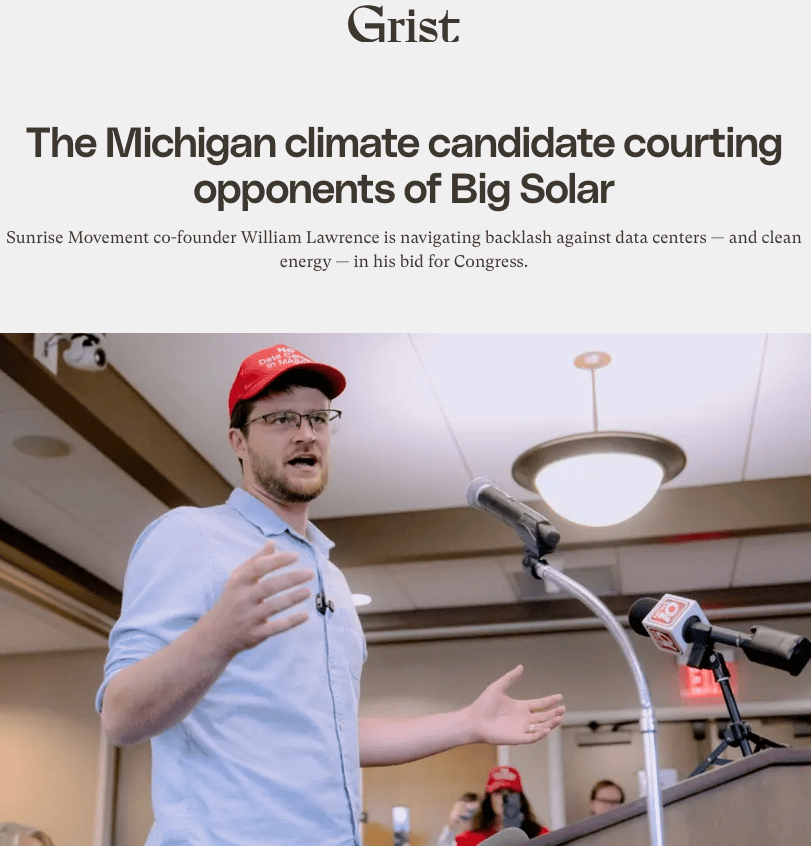
A very thorough and well-balanced article out of the Grist this morning on William Lawrence’s campaign, data centers and solar.

Doug Bessette, PhD, Associate Professor, Department of Community Sustainability, Michigan State University
A very thorough and well-balanced article out of the Grist this morning on William Lawrence’s campaign, data centers and solar.
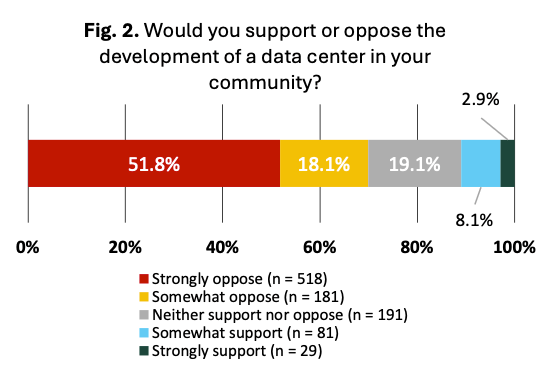
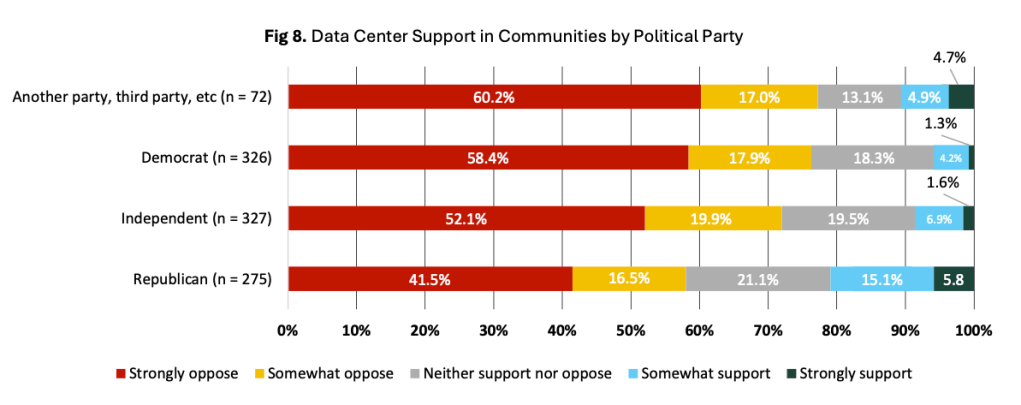
Members of the Energy Values Lab at MSU have published a short report containing key findings from a portion of the Summer 2026 Michigan State of the State Survey (SOSS 94). The SOSS is administered by the Institute for Public Policy and Social Research (IPPSR) of Michigan State University and is a public opinion survey of adult citizens in Michigan. The analyses, interpretations, and conclusions below and in this report are solely those of the authors. They do not necessarily represent the views of IPPSR or of Michigan State University.
The report focuses on residents’ perceptions of and support for data center development in Michigan.
The report is free to download and distribute; however, please cite the report as follows:
Swanson, T., D. Horowitz, P. Borgess, & D. Bessette (October 2026). Michigan residents opposition to data center development. SOSS 94. Institute for Public Policy & Social Research. Energy Values Lab. Michigan State University. East Lansing, MI. http://dx.doi.org/10.17613/vg0my-a7s44
The report was authored by Tyler Swanson, a PhD student in the Department of Community Sustainability; Danny Horowitz, an undergraduate student in the College of Engineering; Paul Borgess, an undergraduate student in the College of Social Science, and Doug Bessette, PhD, an Associate Professor in the Department of Community Sustainability.
Any errors, omissions or inaccuracies are the responsibility of, and inquiries should be addressed to, Doug Bessette, at bessett6@msu.edu.
The SOSS 94 relies on YouGov interviews of 1196 Michigan Residents who were then matched down to a sample of 1000 to produce the final dataset. The respondents were matched to a sampling frame on gender, age, race, and education. The sampling frame was constructed by stratified sampling from the Michigan subsample of the 2023 American Community Survey (ACS) 1-year sample with selection within strata by weighted sampling with replacements (using the person weights on the public use file)
Data availability (currently embargoed): Michigan State University Institute for Public Policy and Social Research. (2026). State of the State Survey 94 [Data file and code book]. Retrieved from http://ippsr.msu.edu/soss/
.
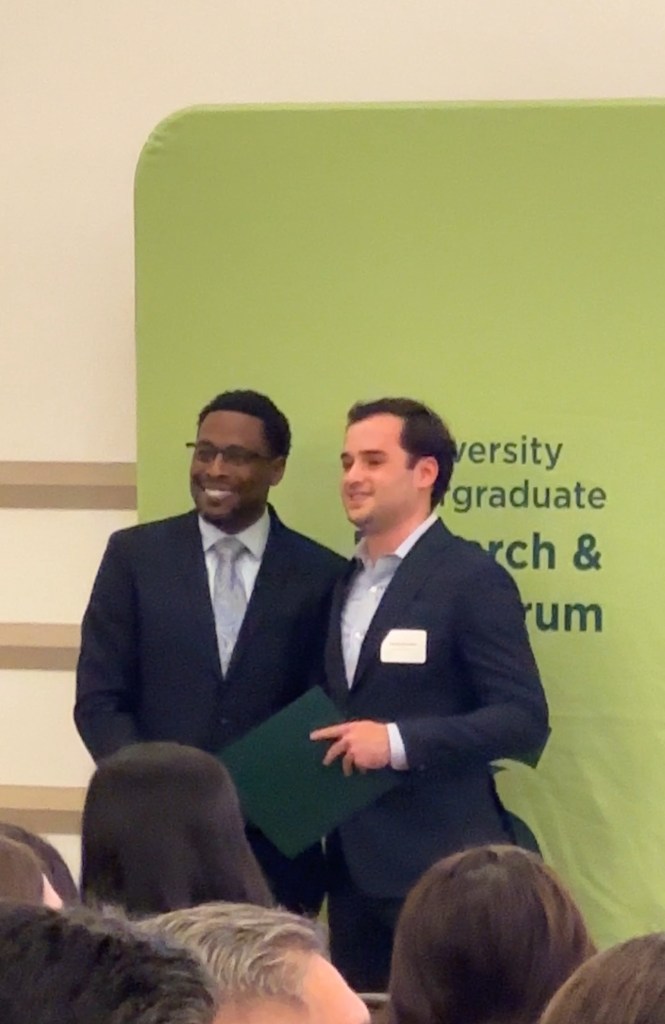
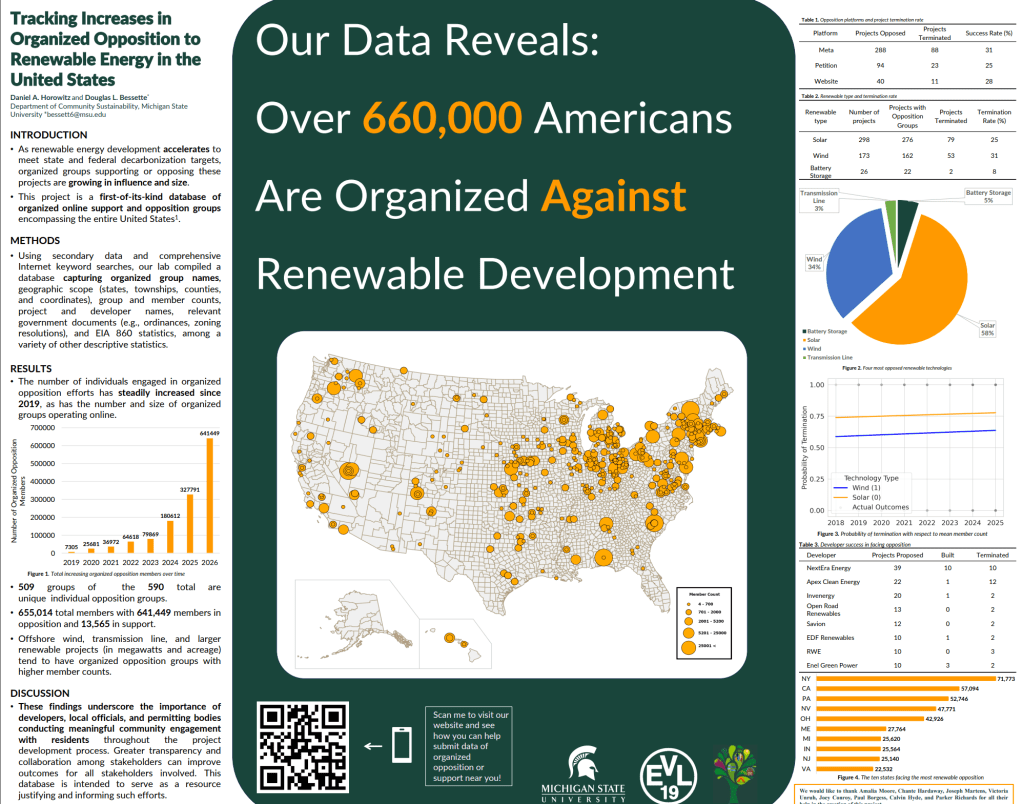
Danny presented his work, Tracking Increases in Organized Opposition to Renewable Energy in the United States, aided by Lab members Paul Borgess, Joey Conroy, Calvin Hyde, Parker Richards, and Tyler Swanson, at MSU’s UURAF and won 1st place in the General Social Science category. Awesome work, Danny!!!
For more on this work, visit www.oppositiondb.com
Danny’s winning poster is below:
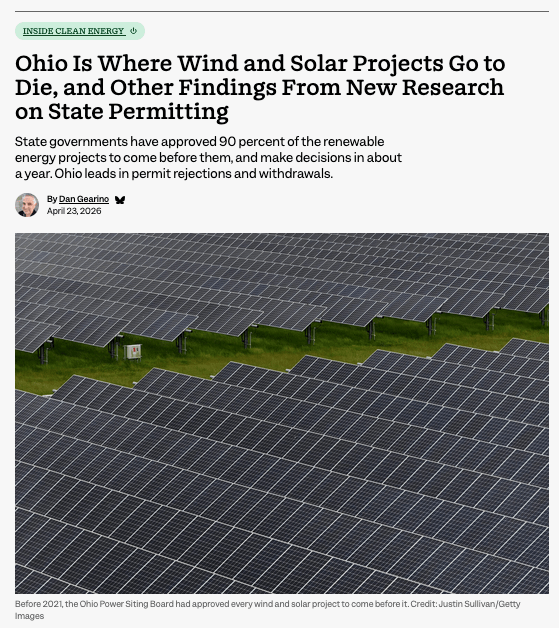
Read Dan Gearino’s story and my comments HERE.
April 14, 2026
In case you missed my talk yesterday organized by MSU’s Library Environmental Committee for Earth Day, which was offered in tandem with How Green is Your Chat? Assessing the Environmental Impacts of AI, here are my slides.
Multiple Temporary Undergraduate Research Assistant Positions: Field data collection for research on solar-farm siting processes in Michigan
Pay: $15 – $20/hour (based on experience/responsibilities)
Timing: Up to 20 hours/wk, 120 hours total, Spring/Summer 2026
Purpose of the position
The Energy Values Lab in the Department of Community Sustainability (CSUS) at Michigan State University (MSU), led by Doug Bessette, is seeking temporary undergraduate research assistants to assist in field data collection for social science research on solar facility (i.e., “solar farm”) siting processes in Michigan in Spring/Summer 2026.
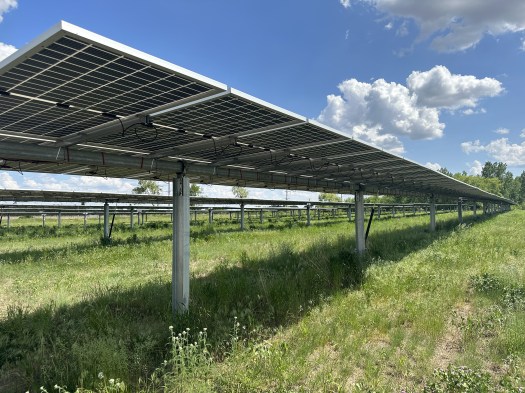
This Department of Energy-sponsored research project includes collaborators from institutions across the U.S. to examine 10 proposed solar projects to determine how solar siting processes can be accelerated while reducing community burden and enhancing opportunities for deliberation. The research will provide a host of community-centered, supported, and tested strategies, including best practices around community engagement, siting and permitting, and land use decision-making, to inform the build-out of LSS in the U.S.
Duties and responsibilities
Student research assistants will be part of the MSU field team responsible for distributing and collecting surveys at 2-3 proposed solar-project sites in Michigan.
Responsibilities may include:
This position requires onsite work based in East Lansing, MI and travel within ~1 hour of MSU’s campus in Livingston, Ingham and Branch counties in Michigan.
Timing:
Applicant interviews will occur beginning in March. Primary orientation and survey preparation work will begin in April. Primary survey drop-off and pick-up will occur during the last week of May and the first two weeks of June. Typical work hours for fieldwork are 2-4 days total, from 8:00AM-6:00PM Monday through Friday and possibly weekends. Additional work within East Lansing may occur through June.
**There may be an opportunity for survey drop-off and pick-up work to begin in March/early April.**
**Longer-term positions/work potentially available**
Knowledge/Experience required
Must be able to organize work, collect and analyze data, keep records, and make independent decisions. Ability to complete assigned special projects with minimal supervision.
Other required qualifications:
Preferred Qualifications:
Location
Supervisors
Title of Position:
Student Research Asst I/II
Start Date:
3/25/26
End Date:
6/30/26
Scheduled Weekly Hours:
Up to 20
Number of Openings:
6
Compensation:
$15-$20/hour
Pay Rate Type:
Hourly
TO APPLY: Email your Resume/CV and Cover Letter explaining your motivation for applying, your relevant work experience, and your availability, to Professor Bessette at bessett6@msu.edu.
Use the EXACT email subject line: “APPLICATION FOR EVL SOLAR RESEARCH ASSISTANT POSITION.” Application Deadline: 12:00pm, March 10, 2026.
My comments about the new proposed data center in Lansing in the City Pulse.

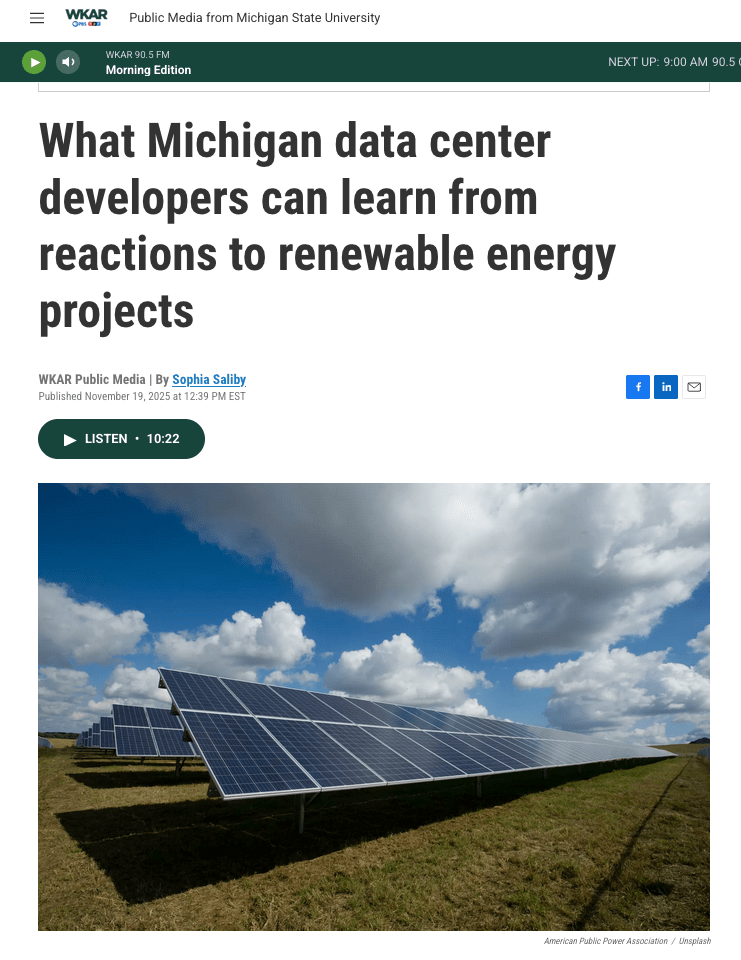
Here me discuss how community engagement and impacts from solar can inform how we should approach data center development on WKAR!
Our paper identifying what community “misengagment” around large-scale solar tends to look like, i.e., single-objective, insular, hostile to opposing perspectives, reliant on confirmation bias or misinformation, and how we created our community-centered solar development (CCSD) approach in response is now available.

Not sure I totally agree with the way this article summarizes our results, but nevertheless here’s our study described in PV Magazine!