Friday, November 10th, 2023. (Draft Version! More figures to come!)
Per the NY Times, a bundle of clean energy bills in Michigan were given final approval in the Senate on Wednesday that would move the state closer to net zero. The bills would require the state to “generate all of its electricity from wind, solar and other carbon-free sources by 2040” and “streamline permits for new wind and solar power” by preempting local control and placing permitting authority for large-scale wind and solar farms in the hands of the Michigan Public Service Commission. The Times reports that Governor Whitmer said “support for the legislation has grown” in Michigan.
But data from Michigan State University’s Institute for Public Policy and Social Research (IPPSR), in particular data from the State of the State Survey (SOSS), a representative public opinion survey of Michigan residents, shows the opposite.
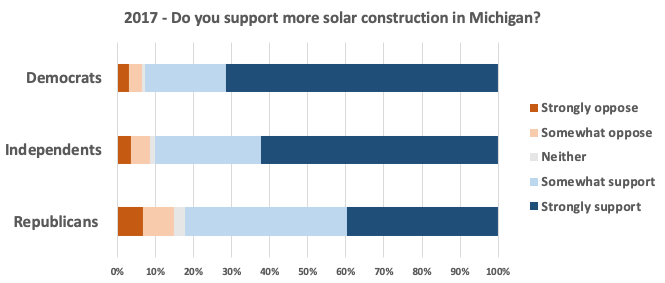
Six years ago, in 2017, SOSS questions asked by Professors Sharlissa Moore and Annick Anctil, both then at MSU (Dr. Anctil remains at MSU), showed that 84% of Michigan residents supported “more wind construction” in the state and 88% supported “more solar construction.”* While in 2017 more Democrats and urban residents supported the construction of renewables than did Republicans and rural residents, all demonstrated consistently high support.

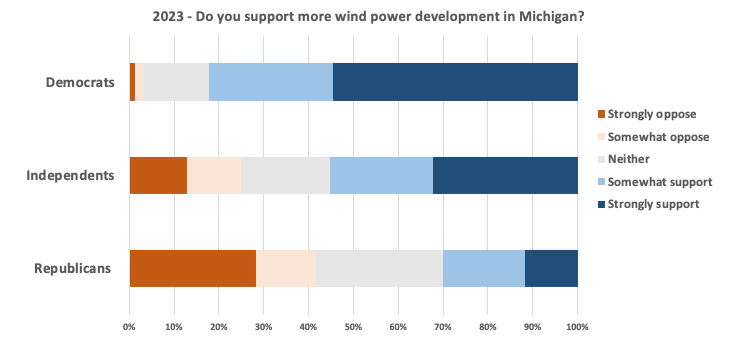
That same survey deployed 7 months ago, in April of 2023, now with questions I asked, showed that support for wind and solar projects has declined considerably. Now only 57% of Michigan residents support more “wind power development,” and support for more “solar power development” has declined to 63%. These aren’t small shifts, but instead pretty clear movement in the direction opposite from what the Governor argued.


But maybe the Governor meant support for these types of projects has grown amongst her party, i.e., the Democrats, rather than with the Republicans. Here she’s got an argument, at least with regard to solar. In 2023, 97% of Democrats support “more solar power development in Michigan,” up from 93% in 2017. But support for wind amongst Democrats has actually dipped a bit since 2017. Only 82% of Democrats now support “more wind power development,” compared to 92% who supported more wind construction back in 2017.
What about Republicans? Well, here we see precipitous drops in support. In 2023, Republicans’ support for more solar power development dipped to just 39% and their support for more wind development dropped even further, to just under a third, or 30%.
Michigan’s rural-urban divide has likely widened since 2017, as my colleagues and I consistently hear concerns from neighbors of projects about where the electricity generated by them goes. These concerns pretty clearly contribute to increased opposition in rural parts of this state and others. So how does support for wind and solar differ between rural and urban residents in Michigan in 2023? Well, considerably. 71% of urban residents support more solar development and 64% of city-dwellers support more wind development in Michigan, while only 57% of rural residents support more solar and 45% support more wind.
But these numbers don’t tell the whole story. Those of us that study support for renewables examine something called the “social gap.” The social gap, identified over 2 decades ago by Bell and colleagues, refers to the difference between what is typically high public support for renewable projects presented in the abstract, often on large surveys like the SOSS, and what is often (much) lower support amongst residents for real projects either being proposed or built in one’s own community.
I couldn’t get around the fact that I’m still asking survey questions, but I could–and did–ask Michigan residents in 2023 about their support for wind turbines or solar farms that would be visible from their residence. It should come as no surprise that support for these projects was considerably lower across the board and the divide between Democrats and Republicans and rural and urban residents remained.
…more to come…
*Any time I have written “support” above I am combining responses from individuals who either “somewhat” or “strongly” supported a technology.
 Energy Values Lab