
One of the chief concerns of rural residents faced with large-scale solar (LSS) proposals are those projects’ impact to the local agricultural economy.
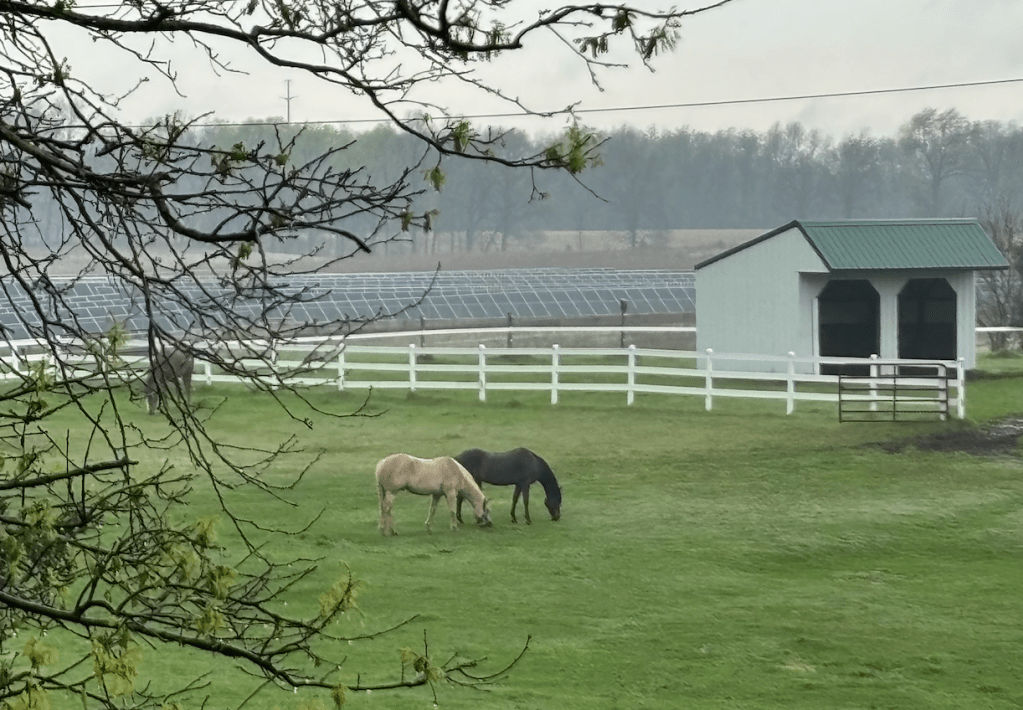
While the construction of LSS creates temporary jobs and economic activity at local businesses, e.g., hotels, gas stations, restaurants and hardware stores, once the project is complete and operational, the full-time equivalents (FTEs) generated by LSS are minimal.
One project-operator told me 1 FTE could manage about 100 MWs of solar.
This doesn’t include landscaper contracts, which can be considerable, but also may be entered into by companies that are ex-local, i.e., “not from around here.” Typically the bigger the project, the less likely your local landscaping company is getting that contract. It’s just easier for operators to sign huge contracts with firms that can maintain hundreds of acres across a region.
Another concern is that tenant farmers can’t pay landowners what solar developers can pay for access to land. Farmers can pay a few hundred dollars per acre, while developers often pay $1000 (or more) per acre. This can drive local farmers out of business.
While much of what you read is about how the overall impact to state or national farmland of LSS may be small (1-2% of farmland lost), if you’re the farmer losing access to land you’ve farmed for decades, that news isn’t encouraging–or even relevant.
But what this recent article and argument made by Jon Baker, the Doral Renewables VP for Development, makes clear, is that there is another unavoidable tradeoff.

Baker touts the environmental benefit of planting ground-cover under and around panels and the lack of production agriculture avoiding pesticide, herbicide and fertilizer use.
To be sure, these are huge, and legitimate, environmental benefits. If you’re a neighbor of that project, your local water quality may improve. Your local ecosystem may benefit from the lack of monoculture.
However, the dollars spent on those supplements are also lost. So that environmental benefit also comes with a significant economic loss. Baker argues his 1300 MW project will avoid 1000 tons of fertilizer annually and tens of thousands of gallons of herbicides and pesticides. Some producer and distributor, perhaps a local one, is losing those contracts.
That’s a huge benefit for the local environment. But also a significant loss to the local ag economy.
And here we see, that there is no silver bullet, there is no “win-win.” There’s a winner, and there’s a loser. And it only depends on what side you’re on to determine which is which.
 Energy Values Lab