
June 19, 2025: Quantity over Quality in Academic Publishing
I recently came upon the Strain Team’s latest blog, Springer Nature Discovers MDPI. While the authors’ oddly named blog may raise some doubt as to its veracity, you should ignore those concerns. It’s an important read.
They write about Springer Nature, MDPI and other “scholarly” journals focusing more, if not solely, on profit at the cost of rigor, and the ever-increasing number (and rate) of poor-quality articles published.
I’ve noticed this shift myself. I’m one of the academics they identify that receives countless emails from MDPI asking me to guest edit “special editions.” I even committed to editing one a number of years ago, only to find that not a single colleague would contribute. They were lucky. MDPI proved itself unworthy of their work, and ultimately published my piece as a stand-alone article at a reduced rate.
That article, which I sometimes read for entertainment, remains the only one I’ve ever published in a MDPI journal and it’s by far the least rigorous and worst article I’ve written. The “review process” was laughable. I’m confident my paper never went out, or was even considered, for review. Instead a MDPI editor, or bot, simply provided a couple suggestions for improving the paper’s structure and clarity, i.e., improve this figure, delete this column from this table, etc.
None of these suggestions demonstrated even a passing understanding of or exposure to the relevant literature or subject matter. –To be fair, not much has been done on vegetable growers’ perceptions of electric tractor transformations, but still…
I’ve not only experienced shoddy “peer review” as an author. Useless and shallow reviews are increasingly common in my role as an associate editor. If i can even find somebody to review an article at all, which is increasingly difficult to do, the reviews returned are often obviously AI-generated or else only critique an article’s structure or clarity. Few of these reviews are of the more difficult, rigorous, and time-consuming variety that requires actual expertise and evaluation in the field of study.
Not to throw my fellow editors under the bus, but I recently served as the area editor for a submission that had already been published, nearly word-for-word in another poor-quality pay-for-play journal. In looking for potential reviewers by searching the article’s title, it emerged quite effortlessly. How the handling editors didn’t discover this themselves is maybe an entirely different problem.
While these poor-quality, structural, most-likely AI-generated reviews lead to more papers being published, they also clearly lead to worse papers being published. These papers don’t engage the literature, or else do so insufficiently, they don’t build on our knowledge, only provide tangents, and they lead to unwarranted confidence in often meaningless results.
Even in the journal in which I publish most, an Elsevier journal EIC’ed by a world-renowned researcher, reviews have become less rigorous, often focusing on structure and clarity, and ignoring my understanding of or referencing of the existing literature. The former reeks of AI and LLMs, the latter (which I greatly appreciate no matter the extra work they require of me) require actual expertise, perspective and attention. This last cost is likely the highest.
Last week, I spoke to a long-time friend and editor of another highly respected Wiley journal, and he told me his new strategy is to simply reject those articles for which he can’t find reviewers. This strategy makes so much sense. If an article isn’t in somebody’s wheelhouse, if it doesn’t inspire another scholar’s curiosity or desire to review, then it’s not likely to be read or cited by anybody else, or move the science in any meaningful direction. And so, it should be rejected. I love this approach.
But such an approach still requires editors and authors to devote considerable time and energy to the process. Both of which are typically uncompensated, and increasingly harder to justify as others (both real scholars and bots) rely ever more on AI and LLM to write, review and publish increasing amounts of hot garbage. To quote the president, SAD!!
March 22, 2025: The real March Madness is having to pay to watch the women, not the men.

It’s March Madness. And though I’ve come to hate those two words–and pretty much everything about college sports, because of NIL, transfer portals, one-and-done’s, it’s the time of year that my wife and I tune in.
MSU is our employer, but we’re also alums, so we bleed green, even though most of the year that blood is inspissated and the color of pea-soup.
As the brackets emerge, both she and I become suddenly anxious, as we begin to care. it sneaks back in. And before we even know it, we care deeply. About both the men’s and women’s teams advancing.
And though lately neither team has gone particularly far, we look forward to watching with baited breath, hoping and willing them to victory.
We watch differently. My wife sits silently with fists clenched. I sit, not silently, pretty much constantly screaming at the screen and questioning every decision, “Why is Fidler in there?! He never plays, what is Izzo doing?! How’s THAT a foul?”
But this year, as we lay out our watching schedule, I noted that the men’s games are all available for free on CBS’s website. Sure you can watch them on Max or Paramount Plus, but worst case, you can stream them for free.

But the women’s games? Yeah, those are behind a paywall. A significant paywall. If you want to watch the MSU women play Harvard, you need ESPNews. That’s $88 for Hulu+Live, or $70 for YouTube TV.
People that are smart know the women’s game is better. It’s a better watch, they run plays, they play as a team, it’s not just jacking 3-pointers and mad drives to the rack.
But you can’t watch those games if you’re a normal person–I consider “normal” not being willing to pay $80 to watch a single basketball game on tv.
And that’s frustrating. Because we/they/I talk a big game about equality (unfortunately I’m statutorily forbidden from talking about equity any more), but this isn’t equal. This is unequal.
Dumb people say that people don’t want to watch the women play. But that’s not it. They’re wrong, mostly cuz they’re dumb, but also because they’re uninformed.
It’s not because they don’t want to watch, it’s because they can’t.
Women’s basketball attracted record viewing last year, MORE than the men’s. Sure some of that was Caitlin Clark and Angel Reese, but it was also because people wanted to watch women’s basketball.
But instead of cultivating that interest, the NCAA and our corporate overlords decided to put women in their place–behind a paywall. OR, as my wife immediately pointed out, even worse they saw an opportunity to monetize that demand.
THIS is the madness, the March MADNESS. And suddenly my wife’s no longer silent. She too is screaming at the screen.
August 1, 2024: Faster isn’t better (unless you’re an Olympic swimmer)
I grew up loving the Olympics, like LOVING the Olympics. I would eagerly watch the prime time coverage every night, taking in the swimming, gymnastics, track, speed-skating, skiing, whatever. It didn’t matter, winter or summer, didn’t matter. I’d take it all in. Growing up in southeastern Michigan meant that I also had access to CBC (channel 9) so I could also watch the Canadian coverage–AWESOME.

And I would be utterly devastated following the Closing Ceremony. It was worse than December 26th.
However as I got older, and the Internet, social media, Google, clickbait, and cell phones became ever more life-altering, the Olympics changed. Whereas once you had to work to find out the results of events that concluded in the morning, or in the wee hours of the night, today, you’d have to be an Olympian to NOT learn the results. You’re barraged by every possible site, poster, blogger, tweeter, colleague, radio DJ. I think successfully staying in the bubble should be a demonstration sport in 2028.
But it’s not just that the results are everywhere that has changed the Olympics. I used to watch events for which I already knew who’d won. That didn’t always matter.
But it’s the coverage. It’s NBC’s coverage. Whereas back in the day, they would play a few sports, a select few events each night, and you’d have to watch a quarterfinal 200 meter butterfly featuring 8 swimmers from southern Europe you’d never heard of and had no chance of winning, and then another one, and another one. You’d have to watch all 32 5-meter divers in a qualification round, and you don’t understand diving, but you WATCHED.
But this year they only play the finals.
They don’t even cover the swimmers coming out of the tent anymore. It’s just a schizophrenic back-and-forth between final events–you can tell that even Mike Tirico doesn’t know what’s coming next. “Are we going to the pool? Nope, we’re going to the dressage arena! Whoops, nope, the soccer pitch!! Ahhh!!”
I’ll say it, it’s awful. Mike’s not enjoying himself any more, and neither am I.
I’ve gone an entire day this Olympics without watching any coverage whatsoever. No highlights, no streaming, no prime time coverage.
My younger self would be shocked and ashamed.
But today. Today y’all. I stayed home. On the couch. And I watched the entire Women’s Gymnastics Individual All-Around (which is a mouthful to say–and write). I fully appreciate how lucky and privileged I am to get to spend an entire day watching television, but that didn’t make it any less fun.
And this event. These women. Wow. Whoa.
But it wasn’t just them, it was the coverage. It was like the old days. I watched one group through all four rotations. Over the course of 2 and a half hours I got to know the Brazilian challenger, the two Italians, Suni Lee and of course–not that i could possibly know more about her–the unreal Simone Biles.
And what was that like? It was TENSE. It was emotional. It was suspenseful. There were ups and downs, momentum changes, boredom! Yes, even a few moments of boredom, god forbid we endure that! Even the athletes sometimes look bored, waiting for the next rotation. But to quote Al Pacino from Any Given Sunday, “that’s what living is!”
And when it came time for Suni Lee to take the floor, she knowing, and WE knowing, that she had to nail her routine to secure a medal, we all felt it. We FELT that shit.
And when she nailed her first pass, with that smile taking over her entire face, and that Lindsey Stirling song pulling at your heart, everything that had grown over the last 2 hours came pouring out. The tears started flowing. I couldn’t compose myself. I started shaking, and clapping my hands, and scaring the dog. –Sorry Molly! It was glorious. I was so proud. Yes, even for a moment, proud to be an American (I don’t say that much these days…)
And when Simone Biles took the floor, well, we all knew what would happen, but we still couldn’t look away. We felt it. We felt the pressure. The tension.
And when she nailed her routine, securing gold, it happened again. We FELT it. It came flowing out. The tears, the joy, the pride.
And we felt like kids again.
ADDENDUM: I now only watch live coverage in the afternoon. I don’t want to take back everything I wrote above, but if you’re lucky enough to be able to watch NBC’s coverage from 10am to 4pm EST, it’s pretty much the same as the old days.
- June 19, 2025: Quantity over Quality in Academic Publishing
- March 22, 2025: The real March Madness is having to pay to watch the women, not the men.
- August 1, 2024: Faster isn’t better (unless you’re an Olympic swimmer)
- June 2, 2024: Need more bomb? Watch Godzilla Minus One
- January 9, 2024: Today in “What are we even doing here?” (Otherwise known as “Completely Unnecessary Studies that will 100% be Used to Fuel Anti-renewables Arguments”
- December 10, 2023: Taxi-cab Confessions
- November 19, 2023: There should be a MTG creature called the Gini Coefficient
- November 3, 2023: We deserve better candy
- October 23, 2023: Easier doesn’t mean better
- October 8, 2023: Jack Fisk, Terrence Malick, Christopher Nolan, and J. Robert Oppenheimer.
- October 4, 2023: Proprioception
- September 29, 2023: Carbon
- September 26, 2023: First Solar & the NY Times
- September 25, 2023: Vincent Van Gogh
- September 24, 2023: The rise and fall of MFM
June 2, 2024: Need more bomb? Watch Godzilla Minus One

My father-in-law Steve is the biggest Godzilla fan I know. He’s also the only Godzilla fan I know. He’s also the only person I know who has seen every old movie, and will often invite us into the room to watch whatever old movie he has on. And when I ask if it is any good, I already know the answer: “Of course it is.”
Unlike my father-in-law, I’ve never been a big Godzilla fan. I’ve seen the older ones, which are better than the newer ones, but I get lost with so many multi-monster releases. First he’s fighting Kong–for the fifth time, then he’s fighting Predator, then somehow he’s in Deadpool vs. Wolverine? I can’t keep up, nor do I want to.
But when I learned of Godzilla Minus One, it intrigued me. I didn’t know anything more about it then we couldn’t get it here in the States, and it had won an Academy Award. Something amazing that I can’t have? Now we’re talking.
Not unlike Godzilla himself, both Steve and I waited anxiously for the film to arrive on our shores, take the country by storm, and leave us in awe, and maybe terror. And after waiting what seemed like months, it did arrive, by surprise, and where we least expected it: on Netflix.
I immediately watched it. My wife slept through it, the whole thing, intentionally, I think as her own way of saying, “we are powerless against the bomb, I will not lie here and wait for it.”
Pretty immediately I realized I was watching a masterpiece (without her), and even better, a BOMB film–if you accidentally read Bond Film, that’s okay, but Bomb films are far better.
I’d always known that Godzilla was an allegory for the bomb, but this iteration didn’t hold back. I’ve been consuming bomb books as fast as I can get them: Kai Bird’s American Prometheus, Richard Rhodes’ The Making of the Atomic Bomb and Dark Sun. I’m pretty steeped in US and Japanese bomb history–recognizing these are American books written by Americans.
But I do know a fair bit about the particulars, and I think as a result Godzilla Minus One was especially satisfying. It discusses critically and expertly Japanese war culture, the US demilitarization of Japan, souring US and Soviet relations, nationalism, patriotism, and of course the existential fear and power that accompanies the bomb (of course). Even the title is amazing.
–this where I’ll argue that if you don’t know anything about the bomb, or the history of the war in the Pacific, this movie is likely to disappoint–
Yamazaki, the director, does all of this critical reflection while using an ingenious mix of special effects, music–both the old and the new, and character development rarely seen in modern movies. It accomplishes these things while echoing Jaws, which Spielberg himself likely made echoing earlier versions of Godzilla.
Even the end of Godzilla Minus One, a bit of a twist, was meaningful and intentional, not like the crap that usually stands in for twists in US movies. There’s actually two twists, I mean the first one. Okay, now that I think about it, there’s actually three twists, but I still mean the first one, the one about Japanese war culture. It was beautiful. And really important.
When my wife finally woke up, during the credits, I regaled her with my gleeful review. I also told her that her dad would be disappointed when he learned that she’d missed it–which I immediately told him about.
Luckily it wouldn’t matter. I knew he’d eventually have it on, and she’d be invited in to watch it.
Update: My wife and I went antiquing this afternoon and we purchased a uranium-glass refrigerator dish. It is glorious and only mildly radioactive:

January 9, 2024: Today in “What are we even doing here?” (Otherwise known as “Completely Unnecessary Studies that will 100% be Used to Fuel Anti-renewables Arguments”
I’m taking a moment out of my busy workday to ask the question, “what are we even doing here?”
A study published today in the Nature Communications journal Earth & Environment by Jingchao Long and colleagues examines changes in global cloud fraction and surface downward shortwave radiation (RSDS) caused by impossibly-sized photovoltaic solar farms deployed in the Sahara desert.
I’m not going to get into the details of the study here. I did actually read the study (it’s available here; the authors’ Conversation article is available here), but rest assured others won’t. That’s important, because as somebody who studies opposition to solar (and wind) in rural communities in the US, I expect this study to have a ridiculously outsized effect on people’s perception of the technology–particularly those fighting the spread of renewables–and in comments at public meetings and conversations on front porches and in gas stations.

A screenshot of Figure 1 from Long, J., Lu, Z., Miller, P. A., Pongratz, J., Guan, D., Smith, B., Zhu, Z., Xu, J., & Zhang, Q. (2024). Large-scale photovoltaic solar farms in the Sahara affect solar power generation potential globally. Communications Earth & Environment, 5(1), 11. https://doi.org/10.1038/s43247-023-01117-5
Despite the explicit acknowledgement in this article that global climate patterns are real and WE CAN CHANGE THEM (ala anthropogenic climate change is real!! shhh…), this study and the hundreds of poorly written, superficial summaries of it will soon “make the rounds” as they say, popping up on every anti-solar website and facebook group across the nation.
“Did you see?! Solar farms make it cloudier! They even make solar farms themselves less effective! [more likely: completely ineffective!”] especially in the US!”
And while, those folks won’t be technically wrong, in that (as the authors model) if we were to build 23.8 TERAWATT-capacity solar farms in the Sahara, those farms could have a small effect on global climate,” my hypothetical response will be to drop my jaw, cock my head and just sink into the corner completely exasperated.
And that’s because there is no response to that sort of comment. It’s completely ridiculous. This “exercise” is completely irrelevant, we will NEVER build solar farms even close to this size in one location. The most extreme scenario, where the global climate changes most, is based off 188.9 TERAWATT-capaciy solar farms. For comparison, all of the solar in the world currently amounts to 1.8 TERAWATTS of capacity. That’s ALL OF THE SOLAR CURRENTLY IN OPERATION IN THE WORLD. Not all in one country, or on one continent, but spread out across the entire world.
So, back to my original question. What are we even doing here?
Well I’ll tell you what, we’re definitely getting clicks! This is the click-bait’iest (is that a word?) article I’ve read in a while. Is it technically sound? Probably. Is it based on precise and accurate data? I mean, probably, but honestly, I have no idea, I’m not a climate modeler (nor are you I bet).
And at the end of the day it won’t matter that it is a “academic exercise.” On main street in rural America and at public hearing in states like Michigan, it will mar efforts to expand renewables. Is that the point? I highly doubt it. But i don’t really know. I guess you’d have to ask the authors, “What are you even doing here?”
December 10, 2023: Taxi-cab Confessions

I arrived at Ronald Reagan Airport at 5pm on Saturday. Unlike DTW, which was eerily empty–my wife and I had just watched Leave the World Behind, so the airport being emptier than usual was extra eerie, DCA was bustling. As usual, as soon as the plane touched down, I opened the ride-sharing app, Lyft, to see not if I could get a ride, but how long I would have to wait, so I could do the hypothetical math to determine if I can walk from the gate to the pickup point in that amount of time. It’s a delicate dance in which I’m sure we all partake.
Lyft said 7 minutes until pickup. That seemed more than enough time to walk what would ultimately take less than 2 minutes. But, then the app began repeatedly re-searching for a driver. Not that one, nope, not this one either, no on this one too. As I waited for the app to update, I noticed something I hadn’t noticed in a long time: a long line of taxicabs, each awaiting a passenger, all right up against the nearest curb, with an airport staffer acting as an eager shepherd.
This seemed way faster, and way more convenient than waiting for this fucking app to find a driver, which I could see on the app were all some distance away. But wouldn’t a taxi be more expensive? I mean, this is why we all shifted to ride-apps in the first place, right? Because cabs were so expensive, and ride-apps were purposely, strategically charging rates that were far less than sustainable to get a foothold in markets like DC, right?
Well perhaps the times they be a-changing because the cheapest Lyft ride to downtown was $27, and the taxi-cab ride was being advertised as approximately $19. So I’m starting to put 2 and 2 together at this point. The cab and its driver are already here, they’re less expensive, the cab company likely pays its driver a living wage (or at least closer to living than Lyft), oh, and by the way the cab is a Prius. This is a no-brainer.
And then it happened. I realized that I would have to actually TELL the driver where I was going. He and I would have to communicate. When I said the Westin, he said, “Which one, there’s more than one.” I looked into my email and said the one on 9th Street (or whatever). He nodded and we were on our way.
That was it. That was the inconvenience. He and I had to discuss where I was going. Like humans do, with our mouth-words. It took about 15 seconds. Unlike the Lyft app drivers who I never really believe know where they’re going, they’re just following the phone screen, like the mindless robots Lyft and Uber’s executives wish they were, this driver didn’t have a phone screen. He just “knew” where the Westin was and how to get there. He took a direct route; the Lyft algorithm and coders would have been impressed–if not intimidated.
When I arrived, he hit the button on the fare computer and it showed $19. I gave him a large tip because why not.
I hope this isn’t a one-off. I hope that the days of ride-app’ing are over. They were never sustainable, and what’s most amazing is that they were never intended to be. It was only a matter of time before their (lack of a) “business model” would ultimately fail. Yes, Uber is “finally profitable,” but only on the backs of their independent contractors, i.e., drivers, who struggle to make ends meet–Lyft still loses money. I know there are a lot of side-hustlers out there, but I confess, I prefer cabs, and even more so a society that relies on cabs.
November 19, 2023: There should be a MTG creature called the Gini Coefficient
The other day I saw that the Magic: The Gathering card “Black Lotus” was going for upwards of $10,000 on eBay.

It may not come as a surprise to those who know me, but when I was in high school I spent a good portion of my days sprawled out on the hallway floor, just outside the cafeteria, next to my two best friends, playing Magic. We didn’t call it MTG back then, just “Magic.” It didn’t exist online, only in real life (or IRL?), and you could only buy cards at the hobby shop or card store. Packs or singles. Or you could trade cards. With your friends. I know, the thought is abhorrent now.
Instead of eating lunch, I would just buy a single box of Lemonheads–see my next post, eek! and I would suck on them until the canker sore grew too large to be ignored, which was typically around the time the bell signaled 4th period was about to begin.
I’m not embellishing when I say that playing Magic was some of the funnest time of my life–it was playing-centerfield-in-baseball (or softball)-level fun to me. I couldn’t get enough.
To those in the know, red was my color. Eventually I would play exclusively red direct-damage decks. I didn’t know it back then, but I crave structure and order, which is ironic because red’s theme was impulse and chaos. Regardless, simple straightforward strategies were–and remain–my jam. Populating my deck with multiple colors or a bunch of would-be powerful cards that required complex combinations of sorceries or enchantments and significant mana you may not pull for days seemed too random and difficult to plan for. I couldn’t endorse that. I wanted 4 lightning bolts, 4 ball lightnings, for the love of God 4 ornithropters! (What was I thinking?!)
Were these red direct-damage decks effective? No. Absolutely not. They were gimmicky and weak. I would cause damage, but never enough to put my opponents in any real danger of losing. Yet I refused to give them up, no matter how many times they lost. I even started to appreciate how bad they were, arguing silently to myself that “one of these days, one of these times, this is gonna work, I’m gonna get the proportions right, and then I’LL BE UNSTOPPABLE.”
But there was another reason I adopted this strategy. And that was because my friend was rich. He OWNED a Black Lotus, which I just learned is considered the most powerful card ever printed, and a member of the “Power Nine.” Even back then, we knew it wasn’t fair. But that wasn’t all. He OWNED 4 Shivan Dragons. He OWNED 4 Sengir Vampires. He OWNED dual-lands–in multiple colors.

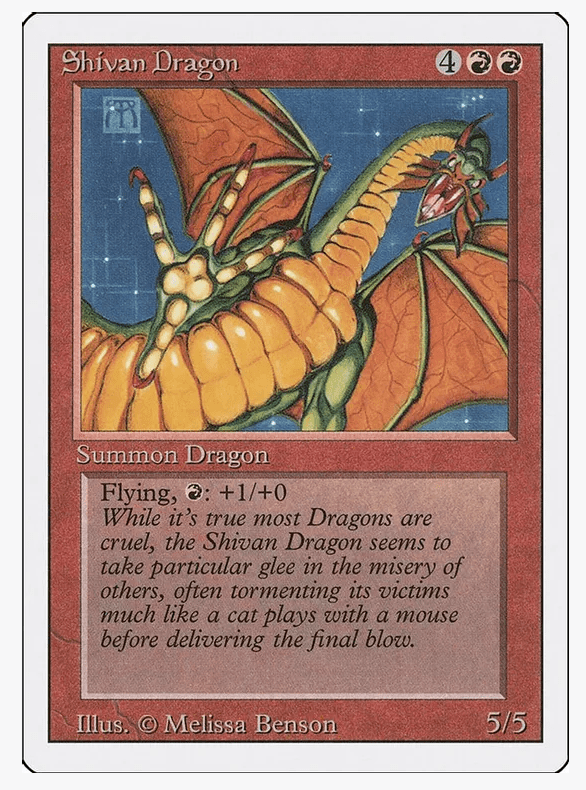
Then as now I realized that I wasn’t going to be able to compete straight up with his deck. Those cards were crazy expensive. A Shivan Dragon was $40, maybe $80? Honestly I don’t even know because they were outside my sphere of possibility. I worked in high school, at a restaurant that was embarrassingly called The Yum Yum Tree. It was fun work and I made decent money. But not enough to buy Shivan Dragons.
My friend didn’t work.
I was bitter about it then, and I remain bitter about it now, reinvigorated by my learning of the price of Black Lotus’s on eBay. But I’m not surprised. It seems a clear example–not that we need another example–of how the rich get richer, and the rest of us keep working, keep trying to get the proportions right, hoping that someday we too will be unstoppable. My friend didn’t do anything to earn that card, or the $10,000 that it’s worth. Not then, and not now.
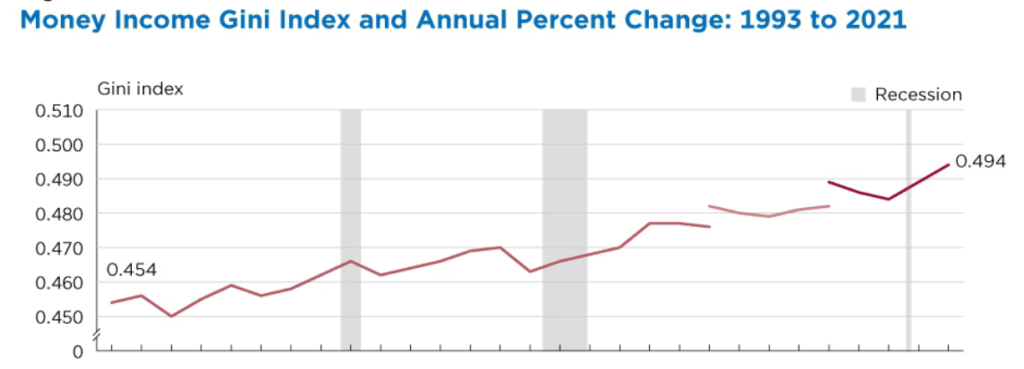
Maybe in their next release MTG should include a creature called The Gini Coefficient. It would be a 11/5 with Trample and Flash and require only 1 colorless mana to play. But it would only be available to the wealthiest players, and it would become more powerful the more you paired it with other cards available only to the wealthiest players.
The thing is, these types of cards already do exist, and YOU can’t afford them.
UPDATE: November 21st. He also had a Badlands. See its price below. Similarly out of reach when I was a kid.

November 3, 2023: We deserve better candy
Last December, in an effort to better understand some heart palpitations I’d experienced since getting Covid-19, I visited my doctor, only to find out there’s nothing wrong with my heart, but instead that I have pre-diabetes. Now, you should know that I’ve long questioned the veracity of this everywhere-machine called pre-diabetes. It could be that extraordinarily irritating commercial featuring the lady dancing and singing about A1C, or my suspicion that pre-diabetes is a marketing ploy by big medicine to introduce new drugs, prescribe unnecessary tests, and raise insurance premiums, or just the pervasiveness of billboards in my city: the other day I saw one that said 89 million Americans have pre-diabetes. I looked over at my wife and said that if 89 million people have a thing, it’s no longer a thing, it’s just part of being human. She couldn’t believe how stupid that statement was.
She’s also correct in arguing to me and anybody else who’ll listen that this diagnosis, regardless of its veracity, was crucial in getting me to stop eating sugar. Like full-stop. Immediate. Overnight. Entirely.
I’ll admit, I was terrified. Do you know what diabetes does to your cells? Have you looked into it? It’s fucking terrifying. Not only that, but I was terrified of becoming a person with diabetes–it’s so stigmatizing! Diabetes?! Me? I run, and do yoga! How could I have diabetes?! I didn’t want that stigma attached to me; it belongs to other people, certainly people that don’t run and do yoga.
And so I stopped eating anything with added or refined sugar. Granola bars, cereal, pop tarts, muffins, cookies, candy, anything that had more than 6 grams of sugar, and that I used to consume two or three at a time, I immediately stopped eating. My late-night bowls of ice cream? Gone. And this wouldn’t just be for a couple days or weeks, or a month, this would be: forever. (to all you sweet-teeth out there: I suddenly felt remarkably better. I used to feel awful, literally everyday, stomach aches, bloat, gas, discomfort, malaise, just a host of awfulness. Going to bed wasn’t as much about getting rest, but more about escaping my digestive demons. But suddenly I felt great. I was eating less, smaller portions, healthier food, more fiber, and suddenly I felt terrific. I also lost 15 pounds. Which was just nuts. I was pretty slim already, so this wasn’t a goal, and honestly I didn’t think it was possible based on my body shape and frame. And, yet, suddenly my jeans were too big and my 44-year old baby fat started to disappear. Weird.
Ok, but I’m getting way off track, jump-cut to Halloween, a holiday literally built on refined sugar. Halloween was once just a day, but now as my wife has wondered aloud it has become a week of candied events, trunk-or-treats, candy bowls at work, all of which rely on and promote children (and adults) capturing as much sugar as possible in a bag, storing that bag under their bed, eating it one piece at a time throughout the day, literally to the point of making themselves sick–sorry, this is what Halloween meant to ME, maybe not everybody.
But there’s so much more that’s wrong with Halloween! And mostly it’s that THE CANDY SUCKS!
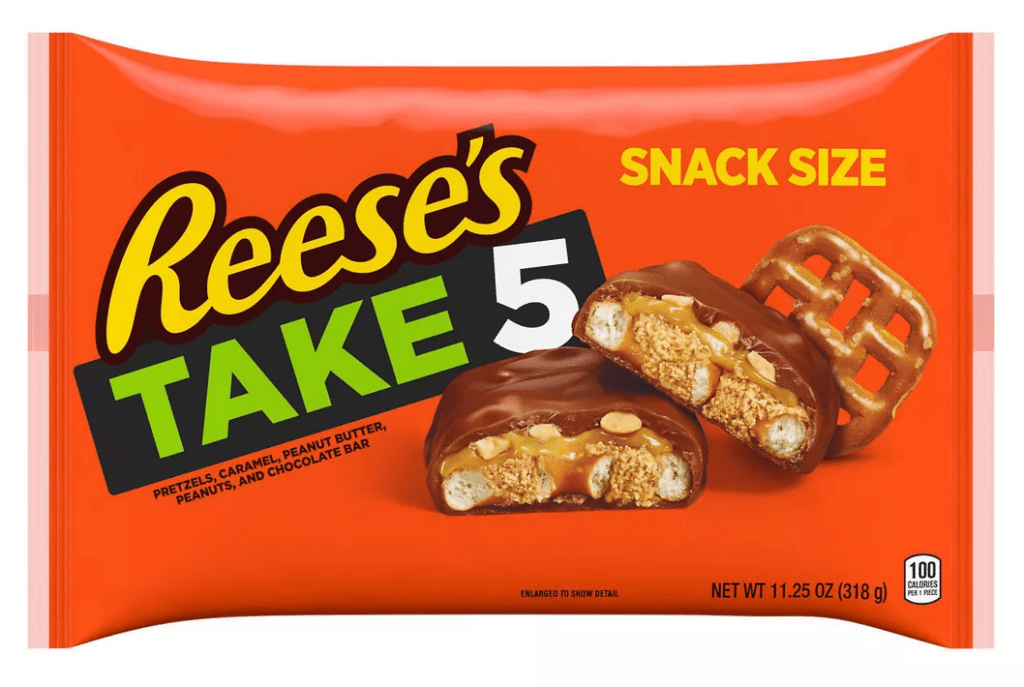
My sister has for years been arguing that candy doesn’t taste as good as it used to. I’d long thought she was crazy, but I now agree. She’s right. And you know why? Because it’s not chocolate any more. It’s corn syrup. Reeses? Snickers? 3 Musketeers? Bite into one and notice how little chocolate you taste. It’s been removed. It’s now just corn syrup, and while corn syrup is sweet, it doesn’t taste like chocolate.
Halloween also used to be about collecting different types of candy. That was the goal. And that was because so many candy companies only sold their own candy in bulk. So to get a high variety, you HAD to go trick-or-treating. Your parents might only hand out Almond Joys and Mounds (GROSS!), or Butterfingers (HELLS YES!). Either way you had to trick-or-treat to get sufficient variety. But now? The consolidation of candy companies has led to only a few companies making all of our candy, and they just put all of that candy into “value bags,” which are definitely not a value, and sell those bags to our parents. So, we all buy 2-3 bags with 10 different kinds of candy in them, and distribute that candy to children seeking exactly the same 10 different kinds of candy. Why not just dump your value bag into your child’s pillowcase?!
But even if you did, you’d note that most of what you’re dumping into that pillowcase isn’t candy at all, it’s packaging. Somehow the shiny plastic wrapping covering the candy has become cheaper than the corn syrup inside, so candy companies have replaced much of the syrup with plastic. Now when you open a 2-pound bag of Hershey’s miniatures, it’s 60% packaging. Next year, it’ll be 61. The year after? Well, you get it.
Along with replacing candy for plastic, candy companies have systematically shrunk the size of the candy each year as well. First there was “fun size,” then there was “bite size,” next there’ll be “crumb size.” All of these candies are shrinking! Now you might be thinking: Good! Less pre-diabetes! But you’d be wrong! Because the shrinking of candy is less about value, and not at all about health, and more about how the act of opening candy provides a dopamine hit. The more often you have to open a candy and pop it in your mouth, the more that sweet reward tells your brain that you want to do it again. Why eat one bag of M&Ms that has 100 M&Ms in it, when you can open 10 bags that have 10 M&Ms in it. Candy has become more about the action of eating a piece of candy, and less about the experience of eating candy.
And of course–this isn’t even fun at this point and you all knew this was coming–but you’re paying more for candy too. Way more. And for less and less candy, less and less chocolate, less and less flavor, and more and more packaging, that latter of which must go directly into your garbage because it can’t be recycled.
So what are we all to do? Well there is good news. Sorta, depending on how you look at it. Did you know that 89 million of you already have pre-diabetes?! Yes! It’s true! (supposedly) Now go to the doctor, get diagnosed, feel that terror grow inside you, and never touch a piece of candy again!
October 23, 2023: Easier doesn’t mean better

I collect baseball cards. Though I should say I don’t really collect them as much as purchase them. When I was a kid, I collected them. Sure I purchased some, but my allowance was a few bucks a month, so I could only buy a couple packs here and there. I traded cards with my friend–though he moved away eventually, sealing off that route. And I would go to local card shows, usually after begging my mom to take me–she would sit in the car and wait, so I was only allotted so much time. I had to work hard to find a card, but once I had it, it meant something. I had collected it.
Today all of that is gone. eBay makes any and all cards available, not for collecting, but for purchasing. You can buy anything, as long as you’re willing to pay for it. If you want to buy something on the cheap, you have to try and win an auction that was ill-timed, typically in the morning on a weekday, while others are at work or sleeping–requiring you to wait until the very last second to throw in a bid, and hope that you’re last–this of course requires a decent Internet connection. When you win won of those, it feels good, but it doesn’t feel like you collected anything, it just feels like you, well, you won something.
Topps isn’t helping, or excuse me, Fanatics–they’re the last company making baseball cards. They’ve created far too many high-value “parallel” cards and “certified autograph” cards, which are cards signed by players in the 1000s, ruining what was once unique, and somehow devaluing “in-person” signatures. Yep, cards signed in-person, requiring actually meeting the player, are somehow worth less (way less) than cards signed in a distant hotel room as part of a 5 or 6-figure contract with Fanatics. Go figure. What is clear is that collecting players’ signatures isn’t the same any more either.
But it’s not just baseball cards. One of my favorite presenters in a class I teach about professional development, Ryan Holem, who is fantastic and works for GEI Consulting, urged my students to keep their LinkedIn profile updated. For that’s how employers will find you–or at least vet you. And it struck me that there too the hard work that used to be required to get a job, walking the streets, calling ads, networking, has nearly all been replaced by online announcements, forums, and emails. Sure that’s made finding jobs easier, but it hasn’t made it better. I’d even guess that it’s led to worse employers and worse employees. The next job is easier to find, so is the next employee, why bother to be thorough in either search.
My wife often waxes nostalgic about the fun and patience required in tracking down an amazing song. She’s got near perfect recall of songs, bands and lyrics–it’s pretty awesome. Maybe it developed over the thousands of hours required waiting by the radio, listening, hoping and praying, and then, wait, is that it?! Hit record, oh my god, finally! There it is! DJ, shut up! I want a clean recording! Now, if you hear a great song, you just open Google, or Apple, or Shazam, ask it to identify the track, and you’ve got immediate access. Sure it’s been made easier, but that journey certainly hasn’t been made better.
If it hasn’t become clear already, it likely will soon enough–note the title of this website–that I am a believer that the Internet hasn’t made too many things better, it’s just made them easier. Baseball cards, job hunts, hearing your favorite song, even making friends. Sure you can make a bunch of friends online, that’s easy, but they’re not good friends, you’ll likely never even meet them in real life. So much for getting their autograph.
October 8, 2023: Jack Fisk, Terrence Malick, Christopher Nolan, and J. Robert Oppenheimer.
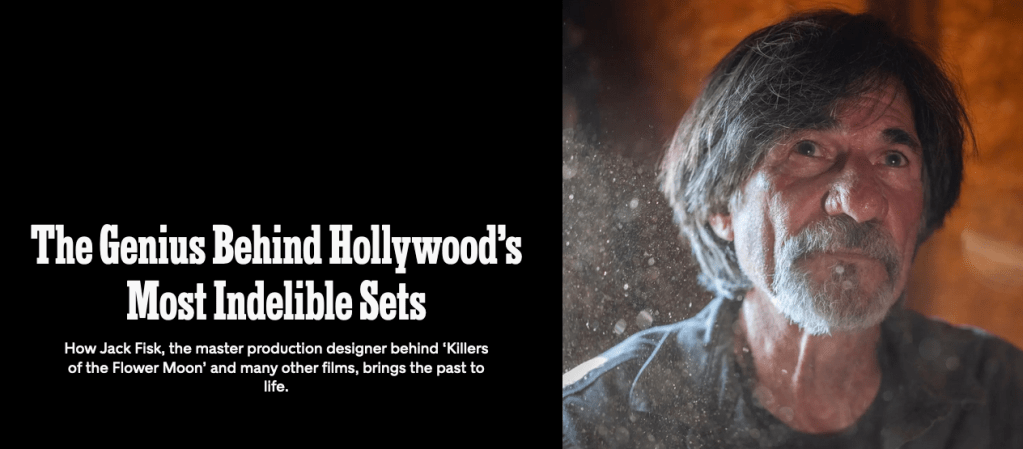
This morning’s NY Times Magazine features an article about the near-obsessive and all-consuming world-building of Jack Fisk, “the master production designer behind ‘Killers of the Flower Moon” –I just finished reading David Grann’s novel on Sunday, let’s just say it was disturbing AF.
Jack Fisk builds worlds, out of wood and stone and wheat. He doesn’t rely on digitization, canvasses, facades or empty drawers–he literally fills the latter with antiques to ensure characters feel authentic if they happen to open one. He doesn’t allow WWII epics to be filmed in Guatemala or Costa Rica, but instead revisits the shores and jungles of Guadalcanal. He built a crude 17th century settler’s fort for A New World out of logs and daub, “a primitive mortar.”
I had never heard of Jack Fisk before this morning. And yet he built the world of nearly every one of my favorite movies, including an adaptation of my favorite book, The Revenant, which as a film also won Di Caprio his long-awaited Oscar. That book tells the (almost) unbelievably stark tale about torture, perseverance and revenge of frontiersman Hugh Glass. If you haven’t read it, you should, but wait til Winter and til dark.
Jack Fisk also teamed up with Terrence Malick, who I argued vociferously for as the best living director much of my young adulthood. But maybe it wasn’t Malick as much as it was Fisk. The Thin Red Line is my favorite movie. I have a line from it, one that was barely uttered as much as coughed out by Sean Penn tattooed on my back: “If I never meet you in this life, let me feel the lack.” I am obsessed with this film’s cinematography, or at least I thought I was until I read about production design. Maybe it wasn’t Malick all this time, but Fisk that I admired so much.
Fisk also built the world for There Will Be Blood, another one of the most influential movies of my young adulthood. Not only did my friends and I quote Daniel Day Lewis insufferably, but it inspired the biggest and best party I ever hosted when I was twenty-seven (or so), milkshake-themed, in period dress, and with a loop of the movie playing in the living room. I read Oil! too, by Upton Sinclair. Not quite as fun!
Fisk didn’t build the world of Oppenheimer, which was directed by Christopher Nolan. Oppenheimber has become my new obsession. Nolan is my (current) favorite director–as I’m sure he is for so many others these days. While he does rely on special effects, he commits to them in a way that I hope impresses Fisk. And his latest, Oppenheimer, relies on a world built in the guise of Fisk, more stone and wood and dust then digital effects. I read American Prometheus immediately following and have a framed portrait of Oppie now behind my desk. There was something about the world built by Nolan that made Oppenheimer real and timeless, and oh so conflicted.
Now when asked my thoughts all I can say about the movie is that I don’t understand how so few of us knew–and continue to know–anything about the most important person that ever lived (sorry, Jesus, but like, seriously). Oppenheimer created a new age. A nuclear age. With slightly less at stake, Fisk, Malick and Nolan build new worlds too. And I’m here for every one of them. Killers of the Flower Moon? Two tickets please.
October 4, 2023: Proprioception
After seeing a call for papers for a conference focusing on “the Pluriverse of transitions: towards anti-colonial and insurrectional energy transformations” I was inspired to write a paper examining the impact of different renewable energy systems on our senses. We often talk about and read about wind and solar’s impact to the “viewshed” or their audio impacts, i.e., noise, but what about their impacts on other senses, like our touch, taste and smell. You might be interested to know that large-scale solar projects may create heat islands (this is a hotbed of controversy and research of late), taking agricultural land out of production under solar may improve water quality–and potentially its taste–by eliminating the use of herbicides, fertilizers and minerals. Pollinator habitats planted between solar panels may have a more attractive odor than manure or diesel fumes.
But what is really fascinating is contemplating how energy systems may impact a “sixth sense” of ours, what is called proprioception. Proprioception captures our ability to sense limb position, movement, tension, force, effort and balance (see Proske & Gandevia, 2012), or more plainly your brain’s awareness of where your body is in space. Close your eyes and start moving your arm around. Note that you know exactly where it is even though you don’t actually know where it is.
I started thinking about how energy systems may affect our awareness of space. Do these sizeable pieces of equipment, think 450 foot turbines or solar farms covering 500 acres, impact not only our viewshed, but what it feels like to be in a place once free of them? What does “open space” feel like with turbines dotting the landscape? How does the soil under our boot feel different when underneath a solar array? Minus these systems, we might hear the corn rustling, or the distant smell of manure, or see an unbroken horizon, and those experiences give us a hint about our position in space. How does the low hum of an inverter, the glare off a solar array, the flicker of a turbine blade, alter that position?
September 29, 2023: Carbon

Last night at a public meeting in central Michigan focused on renewable energy zoning, during public comment, an elderly woman in a sweatshirt featuring two Canadian Geese walked to the podium and said–and i quote: “look outside, these trees need carbon, my son’s fields need carbon, if you do away with fossil fuels, you won’t have carbon for these trees. If you go 100% wind and solar, these trees will die.” At the conclusion of her comments, she left the podium to the sound of raucous applause–most of the people in the room were clapping for her.
September 26, 2023: First Solar & the NY Times

(disclaimer: I’m an investor in First Solar) It’s odd to me that many right-leaning critics of decarbonization in the US argue that domestically manufactured solar panels can’t compete with Chinese panels, and for that reason we should just rely on Chinese made panels–or worse just give up on decarbonization all together. And then in the same breath many of these same critics will argue that any attempt by the federal government to assist domestic manufacturers of solar panels is a doomed Solyndra-esque Socialist plot, conveniently ignoring the fact that Chinese panels are cheap BECAUSE of the incentives and protection the Chinese government provides their own solar manufacturers. And in the same breath, these critics conveniently ignore the incentives provided and the hard-to-ignore extraordinary success of Tesla. You’re either for socialism or against it, pick one already.
September 25, 2023: Vincent Van Gogh

The painting above, or more accurately the digital image of the painting above, was done by Vincent Van Gogh. It is entitled “Enclosed wheat field with rising sun.” He finished it in 1889. It is of course marvelous. I came upon it while trying to find a single non AI-generated painting of a large-scale solar farm. I could not find one. Not a single one. I literally couldn’t. And so I’ve decided–or it has become painfully clear–that solar farms are the least aesthetically or artistically pleasing artifacts imaginable. They are literally unpaintable.
September 24, 2023: The rise and fall of MFM

I cut my teeth in the true-crime-podcast world with My Favorite Murder (MFM) back in 2017. I would listen to Karen and Georgia while driving back and forth from Columbus, Ohio to Lansing, Michigan. I had just started as an assistant professor at Michigan State University, but I was in a relationship with a woman in Columbus. I would drive the sparsely populated US 23 and US 75, having become so familiar with the route that I could check out for what seemed like hours at a time. I’d stop at the McDonald’s just north of Columbus, grab a No. 4, and before I knew what was happening I was seeing the Pure Michigan sign. The whole while I would listen to the Staircase murder case, the Sacramento Vampire, the Golden State Killer, Ted Bundy, all the greatest–and sickest–hits, and for some reason I’d be so at peace. I shared in Karen and Georgia’s bewilderment at these cases. Weirdly, those drives are some of my fondest memories.
And yet now I listen to MFM and am so disappointed. Their “research” is listening to far-better-researched podcasts like Last Podcast on the Left, and more often watching one or two documentaries or even worse a single 20/20 or 48 hours episode. What has this show become? They used to read their own scripted words and mess up, and laugh, and we’d go on that casual journey with them. Now they rarely stop, or laugh, cuz their “script” is written by someone else, a “researcher” that also apparently listens to other true-crime podcasts.
I used to worry that MFM would run out of interesting cases to cover. But instead I think they just ran out of interest in the medium. Or they make enough money now that it doesn’t matter that their show is mundane and boring, their subscriber list is long enough. To quote Oscar Wilde, who couldn’t capture MFM’s fate more accurately, “For each man kills the thing he loves, Yet each man does not die.” Nailed it.
 Energy Values Lab