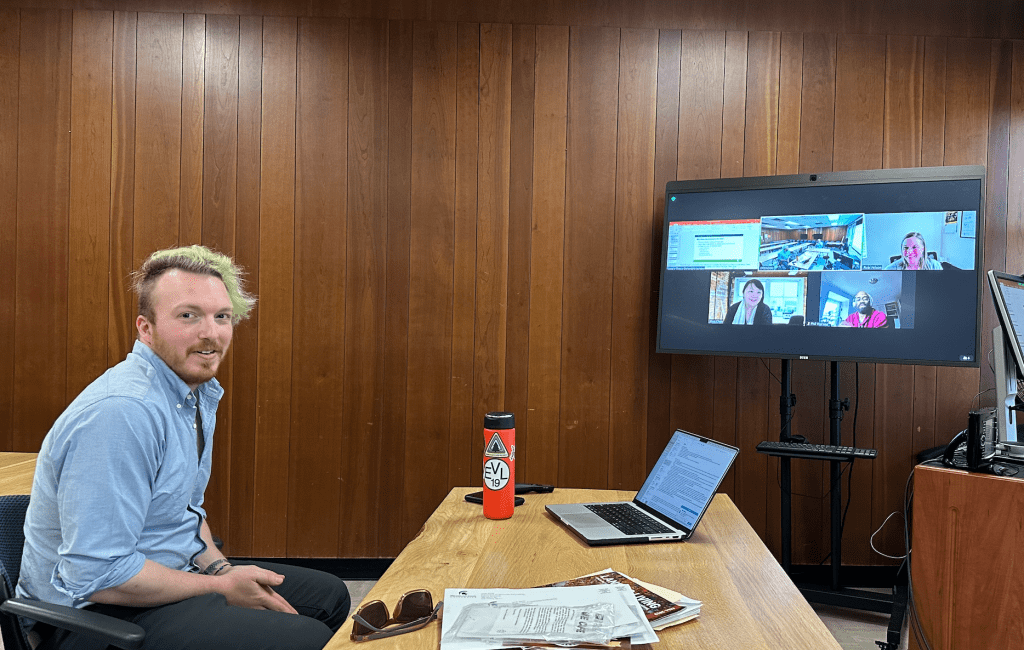
Congratulations to Jake White for defending his MSc. Thesis on urban and brownfield solar development!!

Jake White successfully defended his MSc. Thesis this afternoon examining residents’ perceptions regarding and preferences for alternate development to urban and brownfield solar development in Michigan.

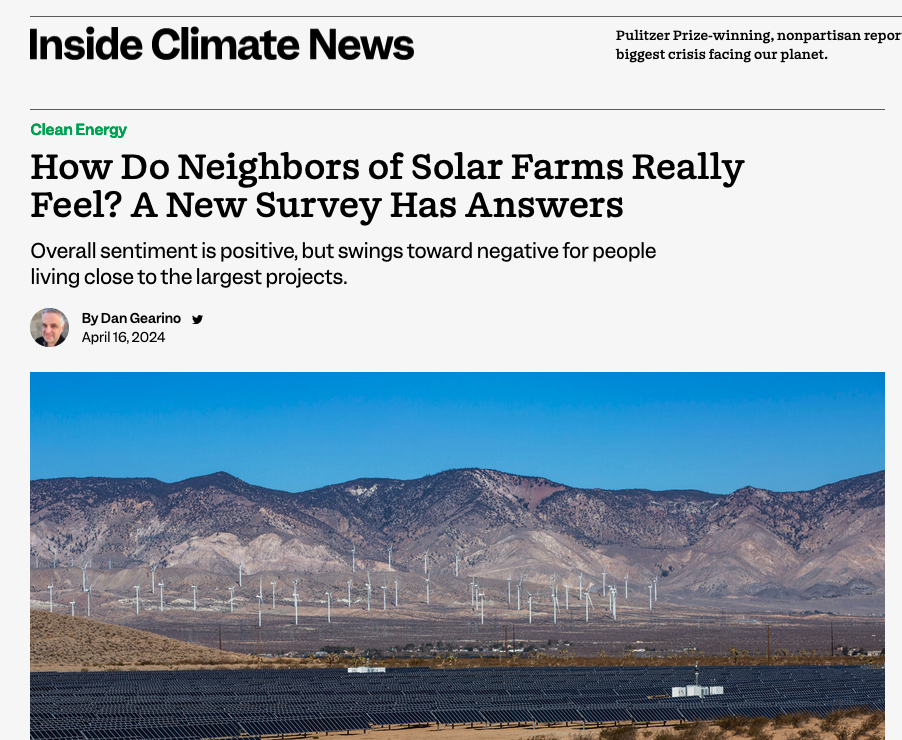
He examined three communities and projects via an Every Door Direct Mail Survey. For more on his work see his Conversation article!

Congrats, Jake! Looking forward to your PhD beginning in the fall!

Detroiters more likely to support local solar power development if they think it reduces energy prices for their community (in The Conversation)

by Jake White!! and I

Michigan residents overwhelmingly want more solar power.

In the spring of 2023, nearly two-thirds of 1,000 state residents surveyed supported additional large-scale solar development.

In the Energy Values Lab at Michigan State University, we study how the public, and specifically community members living near large-scale wind and solar projects, perceive those projects and the processes by which they are approved.

According to a survey we conducted in the fall of 2023 that has not yet been peer reviewed, there may be less support in urban Michigan communities, particularly among those already living close to an existing solar project. Fewer than half of the 158 residents who took our survey supported their local project…

Read more HERE

Featured: Reveal- Sunblocked: Resistance to Solar in Farm Country

Link to Podcast and Story

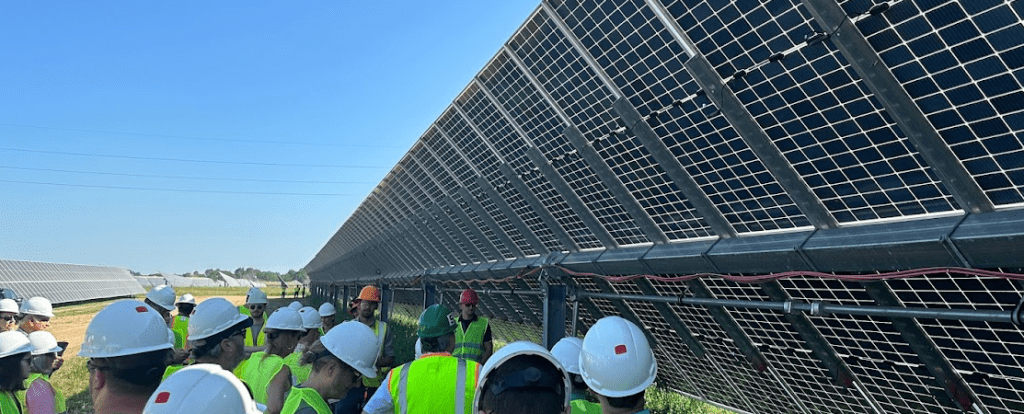
Reveal’s Jonathan Jones travels to Copake, New York, in the Hudson River Valley. It’s the site of one of the most contentious fights over a proposed large-scale solar project in the United States. Jones looks at what’s driving support and opposition to the project, Shepherd’s Run…

…Jones looks at ways agricultural communities are trying to make solar work on their land. This takes him to the Corn Belt, where he looks at how the U.S. is already using millions of acres of farmland to produce a less efficient clean energy source: ethanol. Jones also looks at a landmark agreement between the solar industry and environmental groups convened by Stanford University, which calls for advancing large-scale solar development while championing land conservation and local community interests.

New Paper Alert: (in ERSS) Good fences make good neighbors: Stakeholder perspectives on the local benefits and burdens of large-scale solar energy development in the United States

In order to meet decarbonization goals, the number of large-scale solar (LSS) facilities in the US is expected to increase considerably. The advantages of LSS over fossil-fueled power generation are numerous and well documented. However, residents living nearby proposed and existing LSS sites have voiced a number of concerns about LSS, including its possible impacts to farmland and agricultural production, biodiversity, stormwater runoff, home and property values, as well as concerns about solar panels’ toxicity and safety. While rapid expansion of LSS currently relies on officials permitting and residents being willing to host these systems, the appetite for LSS in some communities may be waning. Here we examine the perceived benefits and burdens of recent LSS developments, conducting 54 interviews with a broad set of stakeholders including residents, officials and developers at seven LSS sites across the US. We focus on identifying residents’ most common concerns regarding LSS systems across states, site types, landscapes and ownership structures. We find concerns are associated with either LSS development processes or impacts, and center on the type and amount of information provided, the community’s influence over project design, the efficacy of community subscription efforts, as well as projects’ economic, environmental, and visual and landscape impacts. Importantly, we also investigate strategies that have been employed to improve perceptions and project outcomes, which include increasing in-person engagement, more explicit discussion of project tradeoffs, third-party intermediaries acting as community champions, and explicit requirements for meaningful local economic benefits.

Bessette, D. L., Hoen, B., Rand, J., Hoesch, K., White, J., Mills, S. B., & Nilson, R. (2024). Good fences make good neighbors: Stakeholder perspectives on the local benefits and burdens of large-scale solar energy development in the United States. Energy Research & Social Science, 108, 103375. https://doi.org/10.1016/j.erss.2023.103375

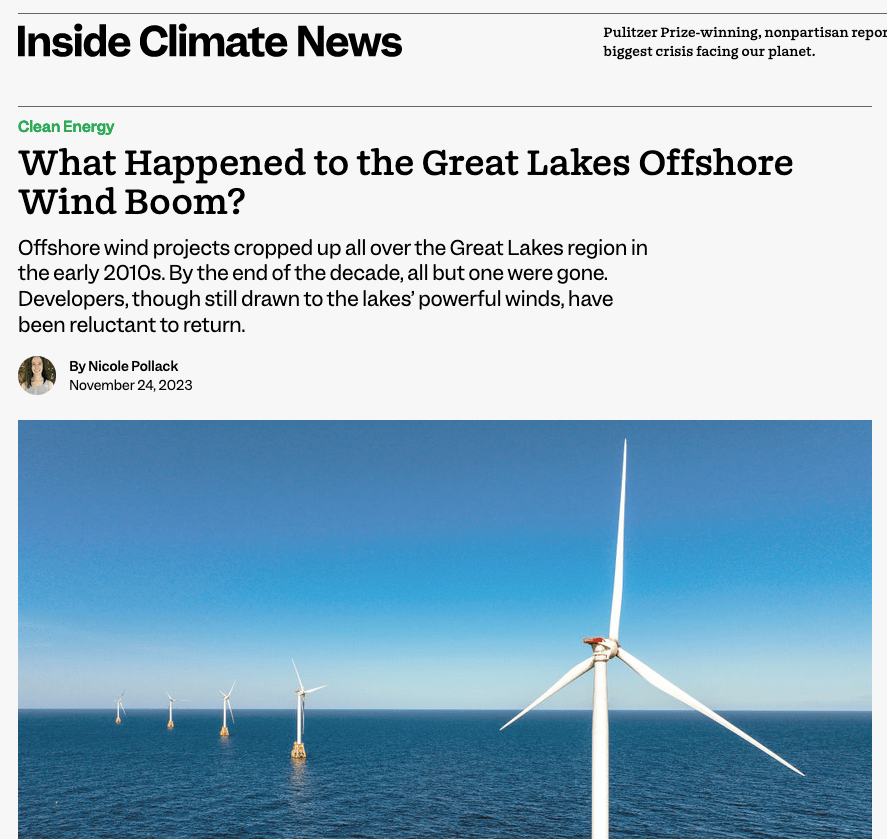
Featured: What Happened to the Great Lakes Offshore Wind Boom?

By Nicole Pollack

CLICK FOR FULL ARTICLE

At the tail end of the aughts, as it became clear that the United States would need to create much more renewable energy, fast, many believed the transition would be bolstered by the proliferation of offshore wind. But not off the coasts of states like Massachusetts and California, where it’s best positioned today. They thought the industry would emerge, and then take hold, in the Great Lakes.

Things looked promising for a while. Glimmers of an offshore wind boom arose from the depths of the Great Recession, as developers offered up proposals on both the U.S. and Canadian sides of the lakes. In 2010, the Cleveland-based Lake Erie Energy Development Corporation, better known as LEEDCo, announced plans to install its first 20 megawatts by 2012 and scale up to 1,000 megawatts by 2020. Two years later, the Obama administration and five states—though not Ohio—formed the Great Lakes Offshore Wind Consortium to help streamline the permitting process…

Featured: Michigan sets ambitious targets for clean energy: Aiming for 100% by 2040

By Rachel Just

CLICK FOR FULL ARTICLE

DETROIT, Mich. — Michigan has officially set new goals to embrace renewable, clean energy in the coming decades.

The plan, deemed “Michigan Jobs, Michigan Energy” by Gov. Gretchen Whitmer, puts into law portions of her “MI Clean Energy Future” plan, which aims to put the Great Lakes State ahead of its neighbors in pursuing clean energy.

“Our 100% clean energy standard will make Michigan a national leader: top five nationwide and number one in the Midwest,” Whitmer told a large crowd gathered at Detroit’s Eastern Market for a bill signing event on Tuesday. “We already knew we were the best, it’s about time the rest of them figured it out. Let’s make it official.”

Whitmer signed seven bills Tuesday, which include ambitions from Whitmer’s priorities that became more pared down during the legislative process this fall.

Goals of the plan include 50% renewable energy by 2030 and 100% clean energy by 2040.

“I would say the goals are very ambitious. But I think that’s part of the strategy, is to set very ambitious goals and hope for the best,” said Doug Bessette, an associate professor in the Department of Community Sustainability at Michigan State University.

Bessette, whose work focuses on clean energy and the energy transition, says he believes Michigan can reach the goals it’s set forth, but it may take a while to accelerate to the major changes it’ll require.

Governor Whitmer says “support has grown” for wind and solar development in Michigan. The data suggest otherwise.

Friday, November 10th, 2023. (Draft Version! More figures to come!)

Per the NY Times, a bundle of clean energy bills in Michigan were given final approval in the Senate on Wednesday that would move the state closer to net zero. The bills would require the state to “generate all of its electricity from wind, solar and other carbon-free sources by 2040” and “streamline permits for new wind and solar power” by preempting local control and placing permitting authority for large-scale wind and solar farms in the hands of the Michigan Public Service Commission. The Times reports that Governor Whitmer said “support for the legislation has grown” in Michigan.

But data from Michigan State University’s Institute for Public Policy and Social Research (IPPSR), in particular data from the State of the State Survey (SOSS), a representative public opinion survey of Michigan residents, shows the opposite.

Six years ago, in 2017, SOSS questions asked by Professors Sharlissa Moore and Annick Anctil, both then at MSU (Dr. Anctil remains at MSU), showed that 84% of Michigan residents supported “more wind construction” in the state and 88% supported “more solar construction.”* While in 2017 more Democrats and urban residents supported the construction of renewables than did Republicans and rural residents, all demonstrated consistently high support.

That same survey deployed 7 months ago, in April of 2023, now with questions I asked, showed that support for wind and solar projects has declined considerably. Now only 57% of Michigan residents support more “wind power development,” and support for more “solar power development” has declined to 63%. These aren’t small shifts, but instead pretty clear movement in the direction opposite from what the Governor argued.

But maybe the Governor meant support for these types of projects has grown amongst her party, i.e., the Democrats, rather than with the Republicans. Here she’s got an argument, at least with regard to solar. In 2023, 97% of Democrats support “more solar power development in Michigan,” up from 93% in 2017. But support for wind amongst Democrats has actually dipped a bit since 2017. Only 82% of Democrats now support “more wind power development,” compared to 92% who supported more wind construction back in 2017.

What about Republicans? Well, here we see precipitous drops in support. In 2023, Republicans’ support for more solar power development dipped to just 39% and their support for more wind development dropped even further, to just under a third, or 30%.

Michigan’s rural-urban divide has likely widened since 2017, as my colleagues and I consistently hear concerns from neighbors of projects about where the electricity generated by them goes. These concerns pretty clearly contribute to increased opposition in rural parts of this state and others. So how does support for wind and solar differ between rural and urban residents in Michigan in 2023? Well, considerably. 71% of urban residents support more solar development and 64% of city-dwellers support more wind development in Michigan, while only 57% of rural residents support more solar and 45% support more wind.

But these numbers don’t tell the whole story. Those of us that study support for renewables examine something called the “social gap.” The social gap, identified over 2 decades ago by Bell and colleagues, refers to the difference between what is typically high public support for renewable projects presented in the abstract, often on large surveys like the SOSS, and what is often (much) lower support amongst residents for real projects either being proposed or built in one’s own community.

I couldn’t get around the fact that I’m still asking survey questions, but I could–and did–ask Michigan residents in 2023 about their support for wind turbines or solar farms that would be visible from their residence. It should come as no surprise that support for these projects was considerably lower across the board and the divide between Democrats and Republicans and rural and urban residents remained.

…more to come…

*Any time I have written “support” above I am combining responses from individuals who either “somewhat” or “strongly” supported a technology.