Factors That Drive Resident Support for Planned Rain Gardens in Urban Neighborhoods

Green stormwater infrastructure (GSI) promises to improve stormwater management while making landscapes more sustainable. The ability of GSI to achieve water quality objectives and provide socioeconomic cobenefits depends in part on public perceptions and support. This study contributes to the literature on public perceptions of top-down, municipal-scale GSI. We examined variation in public support for planned rain gardens and the factors associated with support in a large Midwestern city in the US. We collected survey data (𝑁=588) in two socioeconomically distinct neighborhoods and fit multivariate linear regression models to explore how variables derived from economics, landscape ecology, and outreach and engagement literatures impact support. There was little difference in support between neighborhoods. The expectation of increased property values and improved neighborhood appearance, alignment with personal norms and experience with conservation landscaping, and satisfaction with outreach and engagement programs were significantly associated with higher support. In addition, strong neighborhood identity magnified the effects of several variables. These results suggest that planners should work with communities to identify rain garden designs and locations that balance functionality with aesthetic preferences to minimize potential negative socioeconomic effects while meeting stormwater management objectives. Proactive community engagement that is attentive to local norms and values and identifies appropriate rain garden maintenance plans could improve the long-term effectiveness of GSI by increasing the likelihood of local support.

Time-use among men and women in Zambia: A comparison of grid, off-grid, and unconnected households

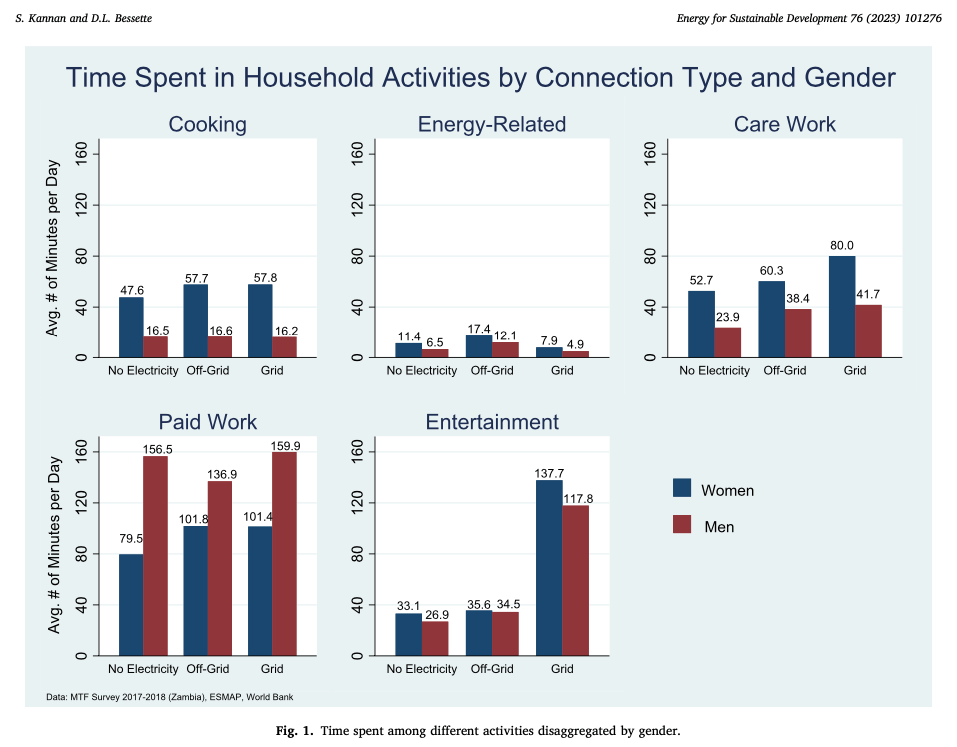
Access to electricity is essential to improving quality of life. The goal of this study is to understand how different types of electricity access affect time use between men and women and identify the everyday activities where electricity may have the greatest impact on women’s quality of life. Using the World Bank’s Multi-Tier Framework (MTF) dataset for Zambia, we apply a Tobit model to examine how male and female household members allocate their time among different activities and the impact of different types of electric connections on those allocations. Our results show that compared to households without electricity, off-grid connections significantly increase women’s time in paid work, more so than grid connections, while grid connections significantly increase the time both men and women spend listening to the radio and watching television. These activities have been shown to be key to empowering women through exposure to women in emancipated roles, decreased fertility rates, lower acceptance of intimate partner violence, and increased shares of divorce and separation. Off-grid connected households showed no difference in television or radio time and increased time in energy-related activities for both men and women compared to households without electricity. These results suggest that efforts to expand grid-connected and off-grid electricity may have different effects on women’s quality of life.

Michigan residents’ support for renewable energy development appears to have declined (considerably). (new data, 7/14/23)

Most studies examining community acceptance of renewables have been based on cross-sectional rather than longitudinal data (Ellis et al, 2023). Here we pursue the latter by comparing the results of two representative surveys distributed in Michigan, the first, an IPPSR State of the State Survey (SOSS) from Fall 2017 (+/- 3.9% margin of error) (see Anctil & Moore, 2018) and the second, a YouGov (SOSS) survey from Spring 2023. Below we share some intriguing trends in what appears to be dramatically reduced support for continued renewable development:

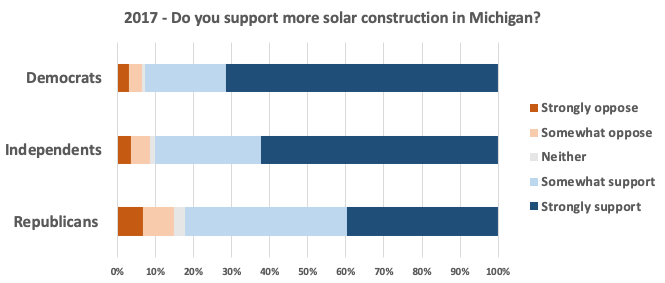
In 2017, 91% of residents supported more solar power development in Michigan. In 2023, only 63% of residents still support more solar power development.

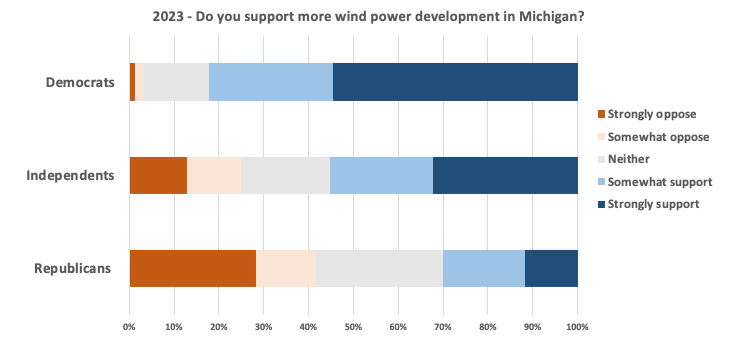
In 2017, 87% of residents supported more wind development in Michigan. In 2023? Only 55% still support further wind development.

Offshore wind in the Great Lakes? In 2017, 76% of residents supported offshore wind turbine development in the Great Lakes not visible from the shoreline. In 2023? Only 50%. Those numbers drop further with respect to offshore wind turbines that would be visible from shore. In 2017, 58% were in support. In 2023, only 38%.

What about electric vehicles? Surely demand for EVs has increased! In 2017, 49% of Michigan residents said that if they could afford one, they would consider purchasing a fully electric vehicle as their next car. In 2023? Only 36% agreed.

Some good news? (Maybe?) In 2017, 73% of Michigan residents supported major increases in the use of natural gas to generate electricity. In 2023, only 39% continue to support such increases.

More to come…

See Michigan State University’s Institute for Public Policy and Social Research for more information about each survey.

Place matters! Rural vs. Urban Michigan residents in support of renewables (new data, 7/13/23)

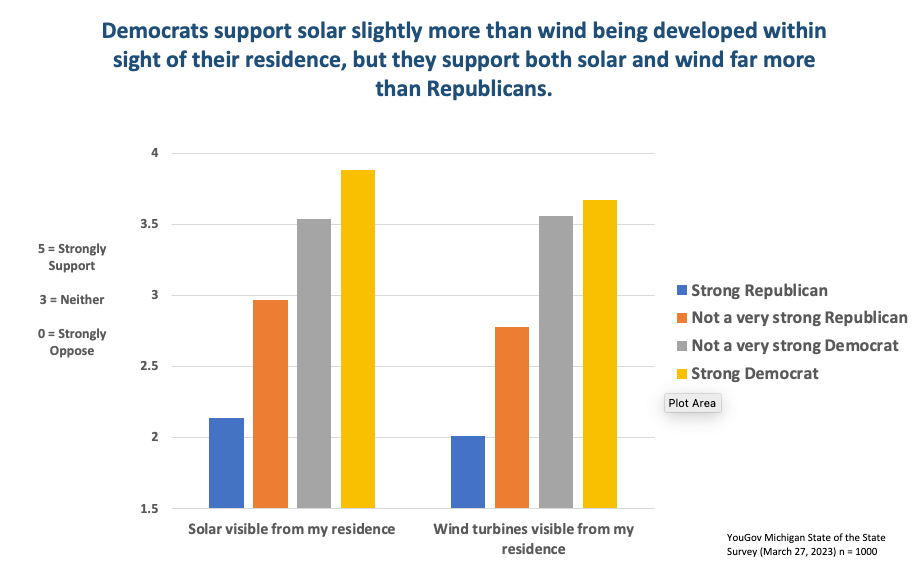
In Michigan (and elsewhere), rural residents, where nearly all large-scale solar and wind development occurs, consistently support renewable development less than do small town, suburban and urban residents, our new data via a 2023 YouGov survey (n = 1000) show. What’s perhaps more telling, when we look at the granular level, at solar and wind being developed within view of people’s residence–and thus a far more significant impact to their viewshed, support declines further, and more precipitously in rural communities.

But what about politics? Do Republicans support renewable development less than democrats?

No surprise here…Yep!

More to come…

Battery Electric Tractors: Small-Scale Organic Growers’ Preferences, Perceptions, and Concerns

Energies2022, 15(22), 8648; https://doi.org/10.3390/en15228648

Abstract

Battery electric tractors (BETs) demonstrate considerable advantages over diesel-fueled tractors, including higher conversion efficiency, higher torque, less maintenance, and no tailpipe emissions. Converting to BETs also requires tradeoffs in the form of the batteries’ high cost, increased weight, limited energy capacity, finite charging cycles, and lengthy charging time. The extent to which small-scale organic vegetable, fruit and cut-flower growers are aware of these tradeoffs is unknown. Little research exists examining these growers’ perceptions, concerns, and willingness to pay for or adopt BETs. Here, we address that gap by conducting qualitative semi-structured interviews with 14 organic growers in the US Midwest, most operating in Michigan. We focus our questions on growers’ motivations, existing tractor-use patterns, and the evaluation of different configurations of a belly-mount open-station cultivating BET. Our results suggest interest in and potential for growers to transition to BETs, including an estimated willingness to pay 14 percent more for a BET compared to a diesel-fueled alternative. This premium is driven by most growers’ preferences for reduced noise, fumes, fuel, and greenhouse gases, as well as beliefs about BETs ultimately being a more sustainable long-term option than diesel-fueled tractors. Growers also identify significant concerns and uncertainty about the long-term performance, maintenance, storage, cost, safety, and weight of the tractors’ battery systems. While growers linked some environmental values and motivations to their interest in BETs, altruistic value signaling was absent, and growers focused considerably more on financial and instrumental concerns and motivations for BET adoption.

Misalignment of perceptions with records and resources for responding to climate change risk

Climate change risks like extreme temperatures and high variability in rainfall adversely affect livelihoods, particularly for farmers in Burkina Faso where the primary sector is agriculture. Decisions on whether to adapt to these risks depend on how farmers perceive each risk and the resources they have available. In this study, we examine how long-term changes in temperature and rainfall are perceived by farmers in Burkina Faso. We also compare the extent to which these perceptions align with actual recorded changes in temperature and rainfall for multiple periods between 1991 and 2014. We use a logistic regression model to analyze the role of resources, such as asset ownership and perceived standards of living, along with household size, age, and gender of the household head to explain differences in perception and ultimately the decision to adapt. Our results show that the vast majority of farmers in Burkina Faso perceive changes in temperature and rainfall; however, only about half of those individuals perceive changes in ways that align with recorded long-term trends in their local temperature or rainfall. The extent to which those perceptions align with recorded changes depends on the time frame selected. Older farmers and those with assets were less likely to perceive temperature and rainfall trends in ways that aligned with climate records; however, farmers’ perceptions of temperature change aligning with records and their perceived standard of living were both associated with the decision to adapt. This misalignment of perceptions with records and resources has significant implications for efforts to inform and support climate risk mitigation and adaptation.

Front. Clim., 02 December 2022
Sec. Climate and Decision Making
https://doi.org/10.3389/fclim.2022.1038320

All’s fair in love and WAR: The conduct of Wind Acceptance Research (WAR) in the United States and Canada

Energy Research & Social Science, Vol. 88, June 2022

Co-authored with Jessie Crawford MSc., MSU CSUS

The number of studies examining social acceptance of wind energy in the United States and Canada has increased considerably since the 1980s. Here we conduct a methodological review of wind acceptance research (WAR) literature in response to four articles published in this journal. These include a recent synthesis of WAR by Rand and Hoen in 2017 recommending better incorporation of results into development practices and comparability of case studies; a 2020 investigation by Walsh and colleagues into potential research fatigue in unconventional oil and gas development research, and finally calls by Sovacool and others in 2014 and 2018 to increase the theoretical depth and reflection in energy social science. Using a systematic review of 114 WAR articles and an online survey of 41 corresponding authors, we investigate the location of WAR study sites, the success of different WAR designs and incentives, the disciplines and theories dominating WAR, and finally dissemination practices. Our results show that, outside national surveys, WAR is geographically concentrated in regions distant from the highest installed capacity and focus on projects that are novel, controversial, or unique to a specific region. We find little support for research fatigue. Additionally, most WAR lacks an underlying theory. We conclude by recommending greater qualitative analysis of study site selection criteria and greater integration of existing WAR theories and WAR with solar acceptance research. Finally, we urge scholars to ensure and communicate a clear purpose, value and financial benefit to WAR participants and meaningfully consider the broader community contexts examined.

Understanding Socio-Technological Systems Change through an Indigenous Community-Based Participatory Framework

Moving toward a sustainable global society requires substantial change in both social and technological systems. This sustainability is dependent not only on addressing the environmental impacts of current social and technological systems, but also on addressing the social, economic and political harms that continue to be perpetuated through systematic forms of oppression and the exclusion of Black, Indigenous, and people of color (BIPOC) communities. To adequately identify and address these harms, we argue that scientists, practitioners, and communities need a transdisciplinary framework that integrates multiple types of knowledge, in particular, Indigenous and experiential knowledge. Indigenous knowledge systems embrace relationality and reciprocity rather than extraction and oppression, and experiential knowledge grounds transition priorities in lived experiences rather than expert assessments. Here, we demonstrate how an Indigenous, experiential, and community-based participatory framework for understanding and advancing socio-technological system transitions can facilitate the co-design and co-development of community-owned energy systems.