You can’t have your cheap solar and make it too

Today’s NY Times article examining China’s efforts to flood the market with cheap solar panels identifies an enduring conflict in the Biden clean-energy agenda: you can’t have both cheap panels and panels made in the US. And for Biden, one without the other is a loss.

Cheap panels mean a speedy transition, more solar farms, more clean electricity, more progress toward his net-zero goals. But cheap panels are made in China. So, more solar development necessarily means more investment in the Chinese solar supply chain, and necessarily less invested in onshoring that supply–bye bye CubicPV!

However, if Biden goes all out, incentivizing, and (hopefully) ultimately relying on, domestically manufactured solar, then the price will inevitably increase, meaning a slower transition, less development, less progress. Slower progress means less wins, which for Biden is essentially the same thing as a loss.

This problem isn’t going away. Navigating it will be difficult, if not impossible. And what’s so frustrating is that this problem is essentially the result of our giving up our competitive advantage so long ago. Not just on solar, but all things manufactured.
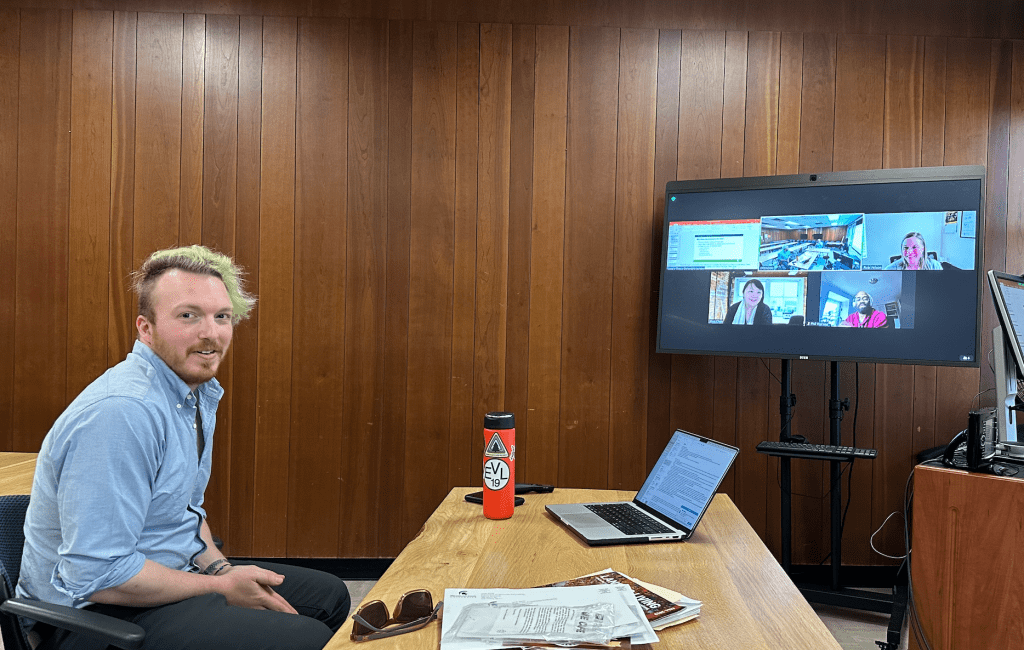
Congratulations to Jake White for defending his MSc. Thesis on urban and brownfield solar development!!

Jake White successfully defended his MSc. Thesis this afternoon examining residents’ perceptions regarding and preferences for alternate development to urban and brownfield solar development in Michigan.

He examined three communities and projects via an Every Door Direct Mail Survey. For more on his work see his Conversation article!

Congrats, Jake! Looking forward to your PhD beginning in the fall!

Detroiters more likely to support local solar power development if they think it reduces energy prices for their community (in The Conversation)

by Jake White!! and I

Michigan residents overwhelmingly want more solar power.

In the spring of 2023, nearly two-thirds of 1,000 state residents surveyed supported additional large-scale solar development.

In the Energy Values Lab at Michigan State University, we study how the public, and specifically community members living near large-scale wind and solar projects, perceive those projects and the processes by which they are approved.

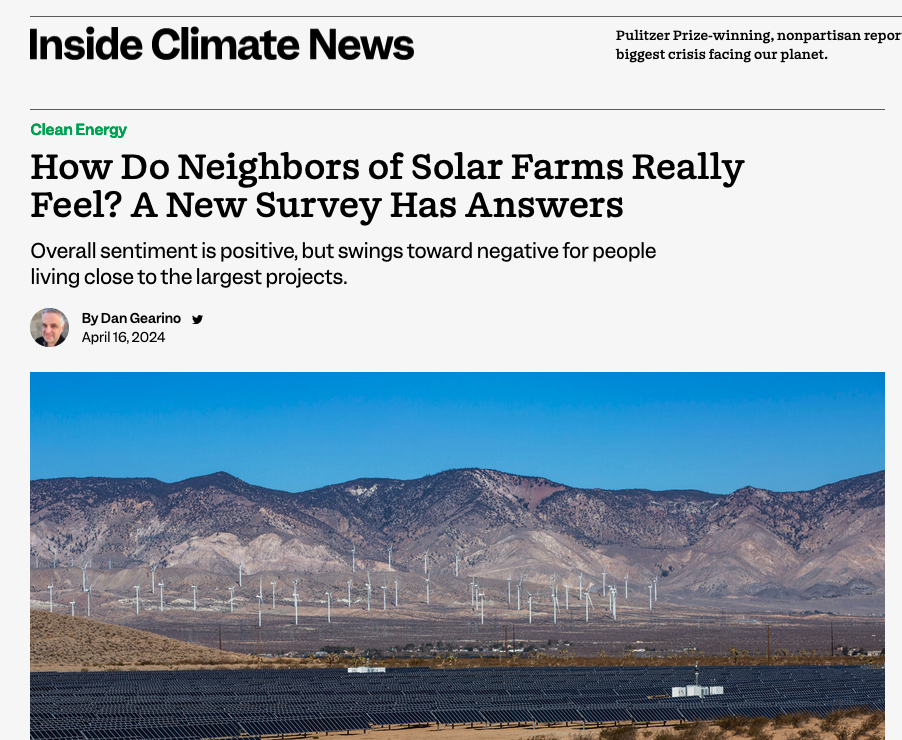
According to a survey we conducted in the fall of 2023 that has not yet been peer reviewed, there may be less support in urban Michigan communities, particularly among those already living close to an existing solar project. Fewer than half of the 158 residents who took our survey supported their local project…

Read more HERE

Featured: Reveal- Sunblocked: Resistance to Solar in Farm Country

Link to Podcast and Story

Reveal’s Jonathan Jones travels to Copake, New York, in the Hudson River Valley. It’s the site of one of the most contentious fights over a proposed large-scale solar project in the United States. Jones looks at what’s driving support and opposition to the project, Shepherd’s Run…

…Jones looks at ways agricultural communities are trying to make solar work on their land. This takes him to the Corn Belt, where he looks at how the U.S. is already using millions of acres of farmland to produce a less efficient clean energy source: ethanol. Jones also looks at a landmark agreement between the solar industry and environmental groups convened by Stanford University, which calls for advancing large-scale solar development while championing land conservation and local community interests.

New Paper Alert: (in ERSS) Good fences make good neighbors: Stakeholder perspectives on the local benefits and burdens of large-scale solar energy development in the United States

In order to meet decarbonization goals, the number of large-scale solar (LSS) facilities in the US is expected to increase considerably. The advantages of LSS over fossil-fueled power generation are numerous and well documented. However, residents living nearby proposed and existing LSS sites have voiced a number of concerns about LSS, including its possible impacts to farmland and agricultural production, biodiversity, stormwater runoff, home and property values, as well as concerns about solar panels’ toxicity and safety. While rapid expansion of LSS currently relies on officials permitting and residents being willing to host these systems, the appetite for LSS in some communities may be waning. Here we examine the perceived benefits and burdens of recent LSS developments, conducting 54 interviews with a broad set of stakeholders including residents, officials and developers at seven LSS sites across the US. We focus on identifying residents’ most common concerns regarding LSS systems across states, site types, landscapes and ownership structures. We find concerns are associated with either LSS development processes or impacts, and center on the type and amount of information provided, the community’s influence over project design, the efficacy of community subscription efforts, as well as projects’ economic, environmental, and visual and landscape impacts. Importantly, we also investigate strategies that have been employed to improve perceptions and project outcomes, which include increasing in-person engagement, more explicit discussion of project tradeoffs, third-party intermediaries acting as community champions, and explicit requirements for meaningful local economic benefits.

Bessette, D. L., Hoen, B., Rand, J., Hoesch, K., White, J., Mills, S. B., & Nilson, R. (2024). Good fences make good neighbors: Stakeholder perspectives on the local benefits and burdens of large-scale solar energy development in the United States. Energy Research & Social Science, 108, 103375. https://doi.org/10.1016/j.erss.2023.103375

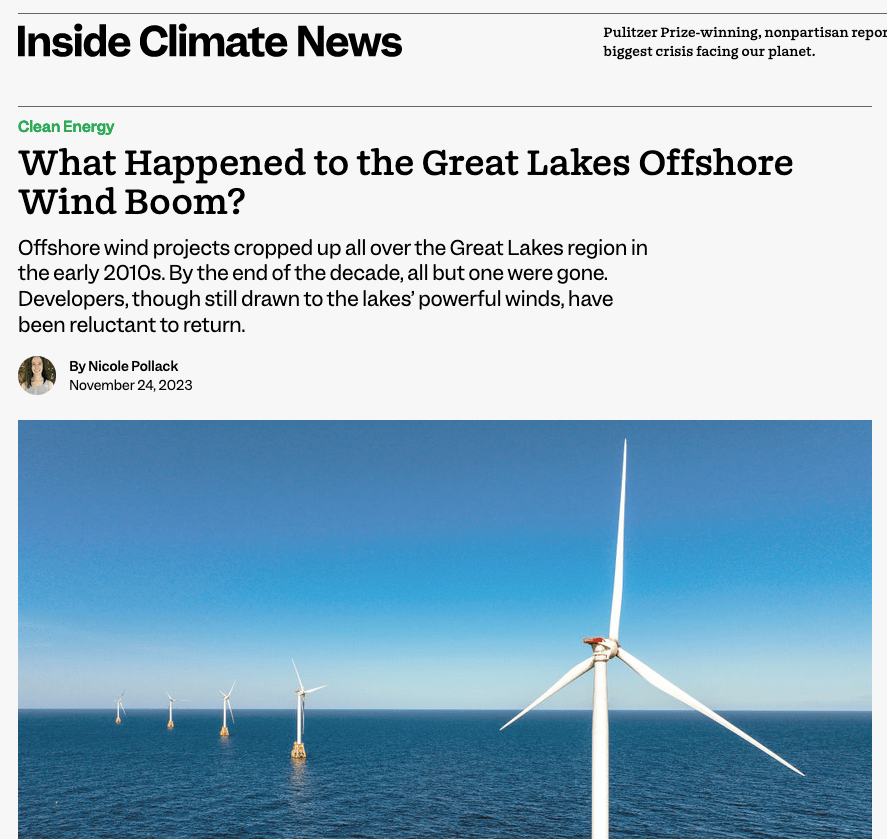
Featured: What Happened to the Great Lakes Offshore Wind Boom?

By Nicole Pollack

CLICK FOR FULL ARTICLE

At the tail end of the aughts, as it became clear that the United States would need to create much more renewable energy, fast, many believed the transition would be bolstered by the proliferation of offshore wind. But not off the coasts of states like Massachusetts and California, where it’s best positioned today. They thought the industry would emerge, and then take hold, in the Great Lakes.

Things looked promising for a while. Glimmers of an offshore wind boom arose from the depths of the Great Recession, as developers offered up proposals on both the U.S. and Canadian sides of the lakes. In 2010, the Cleveland-based Lake Erie Energy Development Corporation, better known as LEEDCo, announced plans to install its first 20 megawatts by 2012 and scale up to 1,000 megawatts by 2020. Two years later, the Obama administration and five states—though not Ohio—formed the Great Lakes Offshore Wind Consortium to help streamline the permitting process…

Featured: Michigan sets ambitious targets for clean energy: Aiming for 100% by 2040

By Rachel Just

CLICK FOR FULL ARTICLE

DETROIT, Mich. — Michigan has officially set new goals to embrace renewable, clean energy in the coming decades.

The plan, deemed “Michigan Jobs, Michigan Energy” by Gov. Gretchen Whitmer, puts into law portions of her “MI Clean Energy Future” plan, which aims to put the Great Lakes State ahead of its neighbors in pursuing clean energy.

“Our 100% clean energy standard will make Michigan a national leader: top five nationwide and number one in the Midwest,” Whitmer told a large crowd gathered at Detroit’s Eastern Market for a bill signing event on Tuesday. “We already knew we were the best, it’s about time the rest of them figured it out. Let’s make it official.”

Whitmer signed seven bills Tuesday, which include ambitions from Whitmer’s priorities that became more pared down during the legislative process this fall.

Goals of the plan include 50% renewable energy by 2030 and 100% clean energy by 2040.

“I would say the goals are very ambitious. But I think that’s part of the strategy, is to set very ambitious goals and hope for the best,” said Doug Bessette, an associate professor in the Department of Community Sustainability at Michigan State University.

Bessette, whose work focuses on clean energy and the energy transition, says he believes Michigan can reach the goals it’s set forth, but it may take a while to accelerate to the major changes it’ll require.